Avoid soil disturbance
Mark the known mycelium area and avoid digging, raking deeply, or compacting the soil there so the underground network remains intact and can fruit reliably in future seasons.

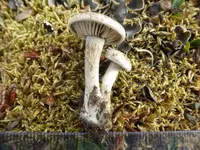
Atractosporocybe inornata is not a leafy plant but a small, ground-dwelling mushroom-forming fungus. It produces pale, modest caps with slender stems and grows in soil-rich forest habitats. The fruiting bodies appear seasonally, often among leaf litter. It is mainly recorded in temperate regions of Europe and parts of Asia. Like many woodland fungi, it forms relationships with tree roots, which influences where it appears and how reliably it returns. Because it is a wild fungus with limited cultivation history, how to care for Atractosporocybe inornata at home is not well established and is considered challenging for beginners.

Care Difficulty
Moderate Care

Light Preference
Partial Shade

Water Requirements
Moderate Water

Temperature Preference
Warm Climate

Hardiness Zone
Unknown

Soil Texture
Loamy

Soil pH
Slightly acidic (6.5–7.0)

Soil Drainage
Well-drained

Fertilization
Minimal (feed rarely)
Scan your plant to receive care tips personalized for your specific plant
Available on iOS and Android
This woodland fungus prefers low, dappled light rather than direct, open sun.
Moist, not waterlogged, soil is essential for stable mycelium development and fruiting.
Stable cool to mild temperatures support reliable mycelial growth and fruiting.
Humidity is not a critical factor for Atractosporocybe inornata, which adapts to typical outdoor ranges.
This species develops best in loose, moist, well-drained mineral soil with moderate organic content.
This woodland fungus is not suitable for container growing, as it relies on complex soil and root associations that containers cannot provide.
This woodland fungus gains most nutrients from decaying organic matter and usually does not need intentional feeding in gardens or containers.
As a mushroom-forming fungus, Atractosporocybe inornata is not managed by pruning in the way vascular plants are.
This species is a mycorrhizal or saprotrophic fungus and is not suited to conventional repotting or transplanting.
Propagation of this wild mushroom is specialized and not recommended for typical home growers.
This temperate fungus is naturally adapted to outdoor seasonal change and needs no special winter care in typical climates where it occurs.

Plant Health Check
Not sure what's wrong with your plant? Check your plant's health inside the app.
This species produces smooth, rusty to ochre-brown spores that help separate it from many superficially similar pale brown agarics when examined microscopically.
Its gills are often described as subdecurrent, meaning they run slightly down the stem, a feature that contributed to its separation from the large genus Tricholoma.
Molecular phylogenetic studies showed that this species did not truly belong in Tricholoma, leading to the creation of the genus Atractosporocybe with A. inornata as its type species, an example of how DNA data reshapes mushroom classification.
This is a little-known gilled mushroom with limited toxicological data. It should be treated as inedible and not collected for food. Many similar-looking fungi are poisonous, so avoid consumption and rely on well-studied edible species instead.
Keep your plants happy and healthy with plant identification, disease detection, and easy care guidance.