Deep root establishment
During the first 1–2 growing seasons, water slowly but deeply in dry spells rather than frequently, to encourage a deep taproot that will make caring for longbract wild indigo much easier long term.

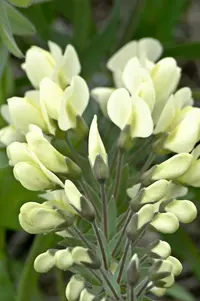
Longbract wild indigo (Baptisia bracteata) is a long-lived, clump-forming perennial in the pea family, native to prairies and open woodlands of central North America. It typically forms low, mounded foliage with arching flower spikes that lean outward, carrying creamy white to pale yellow pea-like blooms in spring.
This species develops a deep taproot and becomes very drought tolerant once established, but it resents disturbance or frequent transplanting. Baptisia bracteata is generally low maintenance when planted in a sunny, well-drained spot, which guides how to care for longbract wild indigo in gardens.
Its seedpods turn dark and add interest later in the season, and the plant often supports native pollinators such as bees and some butterflies.

Care Difficulty
Easy Care

Light Preference
Full Sun

Water Requirements
Low Water

Temperature Preference
Cold Hardy

Hardiness Zone
3–9

Soil Texture
Sandy, Loamy, Rocky

Soil pH
Slightly acidic (6.5–7.0), Neutral (7.0)

Soil Drainage
Well-drained

Fertilization
Minimal (feed rarely)
Scan your plant to receive care tips personalized for your specific plant
Available on iOS and Android
Baptisia bracteata performs best in open, bright conditions that mimic its native prairie habitat.
This deep-rooted perennial prefers infrequent, thorough watering once established.
This prairie species tolerates a wide temperature range once established.
Humidity is not a major factor for Baptisia bracteata, which thrives in typical outdoor air conditions.
Baptisia bracteata prefers dry, open soils with strong drainage and low to moderate fertility.
This species is generally not suitable for long-term container growing due to its deep taproot and mature size.
This deep-rooted native legume generally needs little feeding, especially in fertile garden soil.
Pruning Baptisia bracteata is minimal and mainly focused on tidiness and plant health.
This species develops a deep taproot and dislikes disturbance, so transplanting should be rare and carefully planned.
Reproduction of Baptisia bracteata is most practical from seed, with some patience required.
This hardy perennial tolerates typical winter conditions across much of its range and usually needs little attention.

Plant Health Check
Not sure what's wrong with your plant? Check your plant's health inside the app.
This species flowers very early in spring compared to many other prairie legumes, providing one of the first substantial nectar and pollen sources for emerging native bees and bumblebee queens.
Its long, arching racemes lie close to the ground instead of standing upright, an unusual trait in the genus that positions the pale yellow flowers at the level of ground-dwelling and low-flying pollinators.
As a member of the pea family, it forms symbiotic root nodules with Rhizobium bacteria, helping fix atmospheric nitrogen and enriching the often nutrient-poor sandy or gravelly prairie soils where it naturally grows.

Larvae of several specialist butterflies and moths, including some wild indigo-feeding caterpillars, rely on this plant as a host, making it an important component of native prairie insect food webs beyond its role as a nectar source.
This species is highly attractive to native bees, bumblebees, and some butterflies. Its early, creamy-yellow flower spikes provide an important spring nectar source, making it valuable in prairie, meadow, and wildlife-friendly garden plantings.
Keep your plants happy and healthy with plant identification, disease detection, and easy care guidance.