Staggered Succession Sowing
Sow small patches every 10–14 days in early spring and again in late summer so harvests stay tender and continuous rather than maturing all at once.

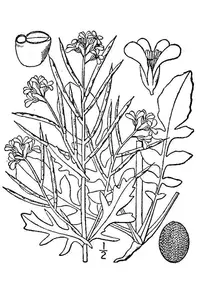
Early yellowrocket, Barbarea verna, is a cool-season biennial herb in the mustard family, often grown as a leafy green rather than a showy ornamental. It forms low rosettes of deeply lobed leaves in its first year, then sends up upright flowering stems with small yellow blooms in the second year.
The plant is native to Europe and western Asia but has naturalized in parts of North America, especially in disturbed soils and moist fields. It grows quickly, tolerates cool weather, and self-seeds easily, which makes it relatively simple to manage once its habits are understood. To care for early yellowrocket, provide sunny to lightly shaded conditions, consistent moisture, and reasonably fertile, well-drained soil.

Care Difficulty
Easy Care

Light Preference
Full Sun

Water Requirements
Regular Water

Temperature Preference
Cool Climate

Hardiness Zone
4–8

Soil Texture
Loamy, Silty, Organic-rich

Soil pH
Acidic (5.5–6.5), Slightly acidic (6.5–7.0)

Soil Drainage
Moist but well-drained

Fertilization
Minimal (feed rarely)
Scan your plant to receive care tips personalized for your specific plant
Available on iOS and Android
Barbarea verna grows best in cool conditions with consistent, moderate sun exposure.
Barbarea verna prefers evenly moist, well-drained soil without long dry spells or soggy conditions.
This cool-season plant performs best in mild temperatures and tolerates light frost.
Humidity is rarely critical for Barbarea verna, which copes well with typical outdoor air levels.
Barbarea verna prefers moist, well-structured soil that drains freely but never bakes hard.
This species adapts well to container growing for leafy harvests on patios or balconies.
Barbarea verna is a fast-growing biennial leaf crop that benefits from light but consistent nutrition in fertile soil.
Pruning Barbarea verna is mainly used to maintain leafy growth and prevent unwanted self-seeding.
This species is most often grown as a short-lived field or garden crop, so focus on careful transplanting rather than frequent repotting.
Barbarea verna is most commonly propagated by seed, which suits its biennial growth cycle and fast establishment.
This cool-season biennial is moderately cold hardy and often overwinters in many temperate regions with minimal intervention.

Plant Health Check
Not sure what's wrong with your plant? Check your plant's health inside the app.
This species has been cultivated in Europe since at least the Middle Ages as an early spring salad and pot herb, valued for its peppery, cress-like leaves when other fresh greens were scarce.
It germinates and grows well in cool conditions and is traditionally sown in late summer or autumn so that it can be harvested very early in spring, often before many other garden crops are ready.
The leaves contain mustard-type compounds called glucosinolates, which give a sharp, cress-like taste that becomes notably more bitter once the plant bolts and starts flowering.

In parts of the southeastern United States, early yellowrocket has escaped cultivation and become a self-sowing field and roadside plant, yet it is still locally grown in gardens as a traditional early spring green, illustrating how closely its agricultural history is tied to cool-season kitchen gardens.
Yes, this species is edible and traditionally used as a leafy green. Young leaves are eaten raw or cooked and have a peppery, cress-like flavor. Older leaves become tougher and more bitter, so harvest early for best quality.
Keep your plants happy and healthy with plant identification, disease detection, and easy care guidance.