Sturdy plant support
Install low stakes or a small cage early in the season to keep stems upright and fruit off the soil, which reduces fruit rot and makes harvesting easier.

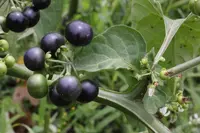
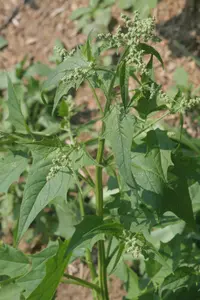
Garden-huckleberry, Solanum scabrum, is a fast-growing annual or short-lived perennial in the nightshade family, grown mainly for its small, dark purple berries and leafy shoots. The plant forms a bushy, upright habit with branching stems and simple green leaves, typically bearing clusters of round berries that ripen late in the season.
It is native to Africa but is now grown in many warm and mild-temperate regions as a minor food crop and ornamental edible. The species is generally considered easy to cultivate, provided it receives ample sun, moderate moisture, and well-drained soil, which makes it straightforward to learn how to care for garden-huckleberry.

Care Difficulty
Moderate Care

Light Preference
Full Sun

Water Requirements
Regular Water

Temperature Preference
Tropical / Frost Sensitive

Hardiness Zone
10–11

Soil Texture
Loamy, Sandy, Organic-rich

Soil pH
Acidic (5.5–6.5), Slightly acidic (6.5–7.0)

Soil Drainage
Moist but well-drained

Fertilization
Moderate (every 2–4 weeks)
Scan your plant to receive care tips personalized for your specific plant
Available on iOS and Android
Solanum scabrum produces best growth and fruit when given consistent, moderate sun exposure in the growing season.
Solanum scabrum prefers evenly moist, well-drained soil and reacts quickly to both drought and waterlogging.
This species grows as a warm-season annual in most climates and needs stable warmth to flower and fruit well.
This species tolerates a wide humidity range and usually does not need special humidity control outdoors.
Solanum scabrum prefers loose, moisture-retentive but free-draining soil to support fast seasonal growth.
This species grows well in containers when given enough root space and stable moisture.
Solanum scabrum responds well to moderate feeding during active growth but does not need heavy fertilization.
Pruning Solanum scabrum helps maintain compact growth and healthy, productive stems.
Solanum scabrum is usually grown as an annual crop, so transplanting timing matters more than long-term repotting.
Solanum scabrum is most commonly propagated from seed for reliable, uniform plants.
Solanum scabrum is typically grown as a frost-tender annual and usually does not receive overwintering outdoors in cold climates.

Plant Health Check
Not sure what's wrong with your plant? Check your plant's health inside the app.
Solanum scabrum is widely cultivated in parts of West and Central Africa as an important leafy vegetable, where its young leaves and tender shoots are cooked and eaten as a staple side dish.
The shiny dark-purple to almost black berries contain high levels of anthocyanins, and in some regions they are used more for natural food coloring and processed products like jams than for eating fresh.
Cultivated S. scabrum shows considerable variation in traits such as leaf size, branching, berry size, and growth habit, reflecting its domestication from different African wild Solanum populations.

In some African communities, specific landraces of Solanum scabrum are preserved and exchanged among farmers as part of local cultural heritage, with named types selected over generations for particular leaf taste, tenderness, and cooking qualities.
The ripe, fully black berries are edible only after cooking and are often used in jams or pies. Unripe green fruits and foliage contain higher alkaloid levels and should not be eaten. Always discard any bitter-tasting fruit.
Keep your plants happy and healthy with plant identification, disease detection, and easy care guidance.