Pinch Early Shoots
Pinch back the top 2–3 cm of new shoots in late spring to encourage bushier plants with more flowering stems and better wind stability.

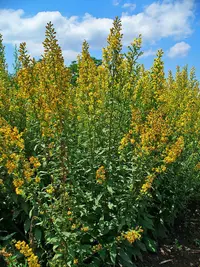
Solidago virgaurea, commonly called goldenrod, is a hardy perennial herb best known for its upright stems topped with dense clusters of small yellow flowers. It typically forms clumps and spreads slowly, creating bright late-summer color in naturalistic or cottage-style plantings.
This species is native to Europe and parts of Asia, where it grows in meadows, open woods, and rocky slopes. It adapts well to garden conditions and is generally easy to grow given enough sun and drainage.
Goldenrod prefers full sun, moderately moist to dry soil, and tolerates relatively poor ground once established. Its toughness and low maintenance needs make it straightforward for gardeners who want to learn how to care for goldenrod without complex routines.

Care Difficulty
Easy Care

Light Preference
Full Sun

Water Requirements
Moderate Water

Temperature Preference
Cold Hardy

Hardiness Zone
3–7

Soil Texture
Sandy, Loamy, Rocky

Soil pH
Acidic (5.5–6.5), Slightly acidic (6.5–7.0)

Soil Drainage
Well-drained

Fertilization
Minimal (feed rarely)
Scan your plant to receive care tips personalized for your specific plant
Available on iOS and Android
Solidago virgaurea thrives in bright, open sites with plenty of direct sun for strong flowering.
This species prefers evenly moist, well-drained soil but becomes more drought-tolerant once established.
This hardy perennial tolerates a wide temperature range but grows best in moderate, temperate conditions.
This species tolerates a wide humidity range and usually does not need special humidity management outdoors.
This perennial prefers moderately fertile, well-drained soil and adapts to a range of textures.
This species can be grown in containers if the pot and substrate are chosen to match its deep, fibrous root system.
Solidago virgaurea benefits from light feeding but grows acceptably in lean soils.
Pruning helps keep Solidago virgaurea tidy and encourages stronger flowering.
This species is usually grown in the ground, so focus on dividing and transplanting clumps rather than frequent repotting.
Solidago virgaurea is commonly propagated by division, seeds, or soft division of young shoots.
This perennial is generally cold hardy and requires only minimal winter care in most temperate climates.

Plant Health Check
Not sure what's wrong with your plant? Check your plant's health inside the app.
This species occurs naturally from western Europe across northern and central Asia to Japan, making it one of the most broadly distributed goldenrods in the Old World compared with North American Solidago species that are often more regionally restricted.
Its small, clustered yellow flower heads produce accessible nectar and pollen that attract a wide range of insects, including solitary bees, hoverflies, and beetles, which helps maintain pollination even in cool or montane climates.
Unlike many other goldenrods that prefer lowland meadows, this species is common in subalpine grasslands, open woodlands, and boreal habitats, showing high tolerance to low temperatures and relatively poor, rocky soils.

In several European countries, this species has been adopted as a reference plant for monitoring airborne heavy metals, because its widespread distribution and leaf chemistry make it suitable for tracking long‑range atmospheric pollution over time.
Lack of flowering often comes from too much shade, overfertilizing with high nitrogen, or crowded, old clumps. Divide every few years, ensure at least moderate light, and avoid rich, constantly fed soil to restore blooms.
Keep your plants happy and healthy with plant identification, disease detection, and easy care guidance.