Contain Spreading Habit
Grow this plant in a bottomless pot or a buried edging strip if planted in the ground, so its stolons (above-ground runners) are easy to lift and redirect or remove before it invades nearby beds.

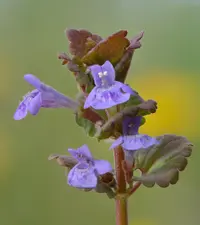
Ground-ivy (Glechoma hederacea) is a low, creeping perennial in the mint family, often forming dense mats that root at stem nodes. Its round, scalloped leaves and small violet-blue flowers give it a soft, carpet-like look.
This species is native to Europe and western Asia but has become widespread in North America, especially in lawns, borders, and disturbed ground. It spreads quickly, which makes it persistent and sometimes invasive in gardens.
Ground-ivy is generally easy to grow, tolerating partial shade, moist but well-drained soil, and a range of temperatures. Understanding how to care for Ground-ivy helps keep it controlled and healthy where it is intentionally planted.

Care Difficulty
Easy Care

Light Preference
Partial Shade

Water Requirements
Moderate Water

Temperature Preference
Cold Hardy

Hardiness Zone
3–9

Soil Texture
Sandy, Loamy, Clay

Soil pH
Acidic (5.5–6.5), Slightly acidic (6.5–7.0)

Soil Drainage
Moist but well-drained

Fertilization
Minimal (feed rarely)
Scan your plant to receive care tips personalized for your specific plant
Available on iOS and Android
This creeping perennial prefers bright exposure with protection from strong afternoon sun.
This plant prefers evenly moist, well-drained soil rather than extremes of drought or saturation.
This hardy groundcover tolerates a wide temperature range but grows best in mild conditions.
This species handles a wide humidity range, so indoor air is usually adequate.
This plant prefers moist, loose, nutrient-rich soil that still drains freely.
This species is well suited to container growing, especially for trailing or edging displays.
Glechoma hederacea grows well in average soil and usually needs only light feeding in containers or poor ground.
Pruning Glechoma hederacea keeps growth dense, prevents tangling, and limits spread.
Ground-ivy is often grown as a groundcover, but container plants or crowded patches benefit from occasional transplanting.
Glechoma hederacea spreads naturally, and intentional propagation helps control where new plants establish.
Glechoma hederacea is cold hardy in much of the US and usually needs minimal winter care in the ground.

Plant Health Check
Not sure what's wrong with your plant? Check your plant's health inside the app.
This species spreads mainly through long, above-ground stolons that root at the nodes, forming genetically identical clonal patches that can persist for many years in lawns and woodland edges.
Its small purple flowers open in early spring and provide nectar and pollen for solitary bees and hoverflies at a time when few other low-growing plants are blooming.
As a member of the Lamiaceae (mint family), it produces aromatic compounds in glandular hairs, which help deter some herbivores and give the crushed foliage its characteristic scent.
Pollen grains of this species have been identified in European archaeological and paleoecological deposits, showing that humans and their environments have been interacting with it for many centuries across a wide range of habitats.
This species spreads quickly via creeping stems that root at the nodes, forming dense mats. In garden beds or lawns it can become invasive. Use edging, regular trimming, or contained areas to prevent unwanted spread when growing Ground-ivy.
Keep your plants happy and healthy with plant identification, disease detection, and easy care guidance.