


creeping Charlie Identification (Glechoma hederacea)

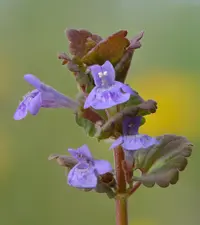
To recognize creeping Charlie, look for round to kidney-shaped leaves with scalloped edges set in opposite pairs on square, creeping stems that root at the nodes.

It forms a low mat, and the small tubular flowers are blue-violet with two lips, borne in clusters from the leaf axils.

Glechoma hederacea Identification

Is This creeping Charlie?

Check your plant ID by uploading a clear photo to Botan.

Clear images work best. Avoid photos taken too close or too far away

Check the plant’s low, mat-forming stems and rounded leaves first.

  • Stems creep along the ground and root at the nodes, forming spreading patches.
  • Leaves are opposite in pairs, nearly round to kidney-shaped, with broad scalloped edges.
  • Leaf blades are usually 1-2 inches (2.5-5 cm) wide, on long stalks, with veins radiating from the leaf base.
  • Flowers sit in small clusters at the leaf axils and are tubular, blue-violet, with two lips.

Square stems provide one more quick visual check.

Creeping Charlie shows useful visual shifts as stems spread, root, and begin flowering.

  • Young plant: Early growth appears as a small mat of opposite, rounded to kidney-shaped leaves on slender creeping stems, with shorter internodes and little upward branching.
  • Mature plant: Established plants form wider trailing patches as stolons root at nodes; leaves are broader and more evenly spaced, and flowering shoots rise 4-10 inches (10-25 cm).
  • Flowering stage: Flowering shoots stand above the creeping stems and carry pairs of tubular bluish-purple flowers from upper leaf axils, making the plant look less flat and more tufted.

In spring, creeping Charlie becomes easier to spot when small violet-blue, tube-shaped flowers appear in the leaf axils, often from mid to late spring. The round to kidney-shaped leaves usually stay green and visible as the flowers rise just above the mat-forming stems. In cold winter periods, top growth may thin or lie flatter, but the trailing stems and opposite scalloped leaves often remain visible, especially in milder regions.

Several low, creeping mint-family plants are mistaken for creeping Charlie.

henbit(Lamium amplexicaule)

It shares rounded, scalloped leaves and purple flowers. Henbit grows upright rather than rooting along runners, and its upper leaves clasp the stem instead of having long leaf stalks.

purple deadnettle(Lamium purpureum)

This also has opposite, toothed leaves and small purple flowers. Purple deadnettle has more pointed, often purple-tinged upper leaves, and it forms a tufted plant instead of a mat with creeping stems.

ground ivy relative(Lamium galeobdolon)

It can spread as a groundcover with opposite leaves. Its leaves are more triangular and often silver-marked, and the flowers are yellow, not blue-violet.

Glechoma hederacea is native to Europe and parts of western Asia. In its native range, it is typical of moist, disturbed places such as woodland edges, hedgerows, shaded lawns, streambanks, and damp field margins. Habitat can help with identification because this species often forms spreading patches in cool, partly shaded ground where turf or low woodland plants are common. Finding it in damp shade, especially around gardens, paths, or creek edges, helps narrow it from less shade-tolerant creeping lawn weeds.

  • Pet ingestion: Glechoma hederacea is toxic to horses, and eating the leaves and stems can cause poisoning. This is an ingestion risk for pets and livestock rather than a skin-contact issue.
  • Human handling and look-alikes: No well-established skin hazard is tied to normal handling. A safety-critical look-alike risk is not clearly established for humans, so identification matters most where grazing animals may eat it.

Scan. Check. Confirm.

Use Botan to identify or verify a plant from a photo, helping avoid mix-ups before you label, remove, or keep it.

FAQ

The clearest feature is its creeping stem that roots at the nodes, paired with opposite, round to kidney-shaped leaves that have scalloped edges and a mint-like arrangement. Small purple, two-lipped flowers appear in leaf axils.

More Plant Identification Guides

From Plant ID to Plant Info

Identify a plant from a photo with Botan, then review plant details, care information, and common problems for that species.

Botan app identifying a plant from a photo
How to Bottom Water Plants: Complete Guide

6 min read · 13 Jul 2026

How to Bottom Water Plants: Complete Guide

Bottom watering helps soil absorb moisture evenly and keeps foliage dry, reducing the risk of missed dry spots or root problems. Place the pot in a tray of water for a short time, then let it drain well.

Plant Care

How to Bottom Water Plants: Complete Guide
Planting Grass Seed in Summer – What Works and What Fails

7 min read · 6 Aug 2026

Planting Grass Seed in Summer – What Works and What Fails

Summer seeding succeeds when the grass type suits the season, and the soil stays moist. Find out how to prepare the seedbed and choose a safe window for planting.

Plant Care
Planting Grass Seed in Summer – What Works and What Fails
Best Time to Water Grass in Summer – Lawn Watering Tips

5 min read · 21 Jul 2026

Best Time to Water Grass in Summer – Lawn Watering Tips

Summer watering is easy to get wrong. This guide explains when to turn on your sprinkler, how much liquid your grass needs each week, and how to tell if you're overwatering or underwatering.

Plant Care
Best Time to Water Grass in Summer – Lawn Watering Tips