Encourage Groundcover Spread
Pin down young, flexible stems with landscape staples or U-shaped wire to encourage them to root at the nodes and create a denser, more weed-suppressing carpet.

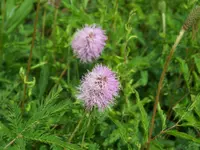
Mimosa strigillosa, commonly called powderpuff, is a low, spreading perennial groundcover in the pea family. It forms a soft mat of fine, fern-like foliage that folds when touched. In warm seasons it produces many rounded pink flower heads, giving a powdery, puffball look above the foliage. The plant is native to the southeastern United States, where it grows in open, sunny sites and sandy soils. It is often used for erosion control, lawn alternatives, or naturalized areas. Once established, it tolerates heat and temporary drought, which makes it relatively easy to maintain. To care for powderpuff, provide full sun, well-drained soil, and moderate moisture without prolonged waterlogging.

Care Difficulty
Easy Care

Light Preference
Full Sun

Water Requirements
Moderate Water

Temperature Preference
Warm Climate

Hardiness Zone
8–11

Soil Texture
Sandy, Loamy, Organic-rich

Soil pH
Acidic (5.5–6.5), Slightly acidic (6.5–7.0)

Soil Drainage
Well-drained

Fertilization
Minimal (feed rarely)
Scan your plant to receive care tips personalized for your specific plant
Available on iOS and Android
Mimosa strigillosa performs best in bright, open sites with plenty of direct sun.
This species prefers evenly moist, well‑drained soil and tolerates brief dryness once established.
This warm‑season groundcover thrives in mild to hot conditions and struggles with hard frost.
This species tolerates a wide humidity range and usually does not need special humidity management.
Mimosa strigillosa prefers light, well-aerated soil that drains quickly but does not stay bone-dry.
This low, spreading species can be grown in containers if managed for its trailing habit and drainage needs.
Mimosa strigillosa is a low-maintenance native that needs only light feeding in most garden soils.
Mimosa strigillosa requires minimal pruning, mainly to tidy growth and maintain flowering performance.
This species is usually grown as a groundcover, so care focuses more on transplanting young plants than on repotting.
Mimosa strigillosa is commonly propagated to spread groundcover using seeds, divisions, or simple layering.
This warm-climate perennial is fairly cold tolerant in much of its range and usually needs little winter attention.

Plant Health Check
Not sure what's wrong with your plant? Check your plant's health inside the app.
This species is widely used along roadsides and highway medians in the southeastern US because it forms a dense, low mat that stabilizes sandy soil and tolerates mowing better than many other native wildflowers.
Its pink, powderpuff-like flower heads produce abundant nectar and attract native bees, small wasps, butterflies, and other insects, making it a valuable component of regional pollinator habitat plantings.
As a legume, it hosts nitrogen-fixing bacteria in root nodules, allowing it to enrich poor, sandy soils while spreading horizontally by stolons to form a living green carpet.

This plant is a host for caterpillars of several native butterfly species, including little sulphur (Pyrisitia lisa), so stands of this groundcover can directly support local butterfly life cycles in their natural range.
This species spreads by creeping stems and underground stolons, forming a dense mat over time. In warm climates it can expand quickly, but it is usually manageable with edging, mowing, or regular trimming along borders and paths.
Keep your plants happy and healthy with plant identification, disease detection, and easy care guidance.