Pinch For Bushiness
Pinch out the soft shoot tips when plants are 10–15 cm tall to encourage dense branching and more flowering stems instead of a few tall, floppy ones.

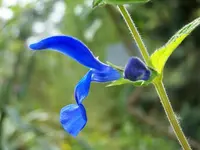
Salvia patens, often called gentian sage, is a herbaceous perennial grown mainly for its vivid blue tubular flowers. It forms loose clumps with upright stems and soft, slightly crinkled leaves. Flower spikes rise above the foliage, giving a light, airy look in borders and containers.
This species is native to Mexico, where it grows in mild, well-drained sites. In gardens it prefers sun, moderate moisture, and soil that does not stay wet, which makes it relatively straightforward to care for sage in temperate climates.

Care Difficulty
Moderate Care

Light Preference
Full Sun

Water Requirements
Moderate Water

Temperature Preference
Tropical / Frost Sensitive

Hardiness Zone
8–10

Soil Texture
Sandy, Loamy, Organic-rich

Soil pH
Slightly acidic (6.5–7.0), Neutral (7.0)

Soil Drainage
Well-drained

Fertilization
Light (every 4–6 weeks)
Scan your plant to receive care tips personalized for your specific plant
Available on iOS and Android
This sun-loving perennial performs best with strong, direct light in most climates.
Salvia patens prefers evenly moist but not saturated soil, with brief drying between waterings.
This species grows best in mild conditions and dislikes hard frost or prolonged extreme heat.
Salvia patens handles typical indoor and outdoor humidity but benefits from moderately dry air.
Salvia patens prefers loose, well-aerated, sharply drained soil to keep roots healthy and prevent rot.
This species grows well in containers when given enough root space and firm, stable support.
Salvia patens benefits from moderate feeding to support continuous flowering without producing overly lush, weak growth.
Pruning Salvia patens keeps plants compact, encourages branching, and extends the flowering season.
This species is often grown in borders but also adapts to containers that may need occasional repotting or transplanting.
Salvia patens is commonly propagated from cuttings, division, or seeds to maintain or expand plantings.
Salvia patens is frost sensitive in colder climates and benefits from targeted winter protection, especially where soils freeze.

Plant Health Check
Not sure what's wrong with your plant? Check your plant's health inside the app.
The flowers produce a rare, clear sky-blue coloration, which is uncommon among garden ornamentals and results from specific anthocyanin pigments interacting with the cell’s internal pH and metal ions.
This species is native to highland regions of central Mexico, where it grows in open, seasonally moist habitats, which explains its preference for cooler summers and good soil drainage in cultivation.
Its tubular flowers and protruding stamens are morphologically adapted to pollination by hummingbirds and long-tongued bees, which can easily reach the nectar while transferring pollen between blooms.

In regions with mild, frost-free winters, Salvia patens can behave as a short-lived perennial that re-emerges from its tuberous roots, while in colder climates it is usually grown as an annual or lifted and stored like dahlia tubers.
Poor flowering usually comes from insufficient light, depleted soil nutrients, or lack of deadheading. Apply a balanced, low-nitrogen fertilizer in spring, remove spent flower spikes, and avoid heavy shade to support repeat flowering through the warm season.
Keep your plants happy and healthy with plant identification, disease detection, and easy care guidance.