

silver birch Identification (Betula pendula)

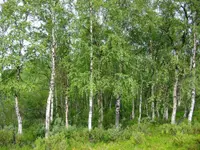
To recognize silver birch, look first for a white trunk with dark fissures near the base and many slender branchlets that hang downward. The leaves are alternate, triangular to diamond-shaped, and usually about 1 1/2 to 3 inches (4 to 7 cm) long.

Long, narrow catkins also help confirm the species.

Betula pendula Identification

Is This silver birch?

Take or upload a photo to confirm your plant ID with Botan.

Clear images work best. Avoid photos taken too close or too far away

Use these visible traits to check for Betula pendula.

  • Crown is light and airy, with many fine branchlets that hang down from the outer branches.
  • Trunk is usually slender and upright, often with dark fissures low down and paler bark above.
  • Leaves are triangular to diamond-shaped, about 1 1/2 to 3 inches (4 to 7 cm) long, with a pointed tip.
  • Leaf edges are sharply double-toothed, meaning each larger tooth carries smaller teeth.
  • Twigs are thin and often slightly rough, sometimes showing small resin warts on the surface.

Check several parts at once, especially the drooping twigs and leaf shape.

Betula pendula shows clear visual shifts from sapling form to flowering and fruiting structures.

  • Young plant: Young plants are narrow and upright, with a slim pale stem and short side branches; leaves are smaller and the pendulous branch pattern is weak.
  • Mature plant: Mature trees develop a distinct white trunk with dark fissures near the base and many long, drooping twigs, often reaching 40-60 feet (12-18 m).
  • Flowering stage: Flowers appear as hanging catkins; the male catkins are longer and more conspicuous, while female catkins are shorter, upright at first, then drooping.
  • Fruiting stage: Fruiting catkins turn into slender, pendant seed clusters that break apart, releasing many small winged seeds, unlike the softer, intact look of flowers.

Several silver birch selections are easy to tell apart by crown shape, shoot habit, or leaf form.

  • 'Youngii': A strongly weeping tree, usually forming a dome-shaped crown with branches that hang downward instead of the species’ more open, upright outline.
  • 'Fastigiata': Narrowly columnar, with steeply ascending branches and a much slimmer crown than the typical broad, airy form.
  • 'Dalecarlica': Leaves are deeply cut into narrow lobes, giving the canopy a fine, fern-like texture unlike the usual triangular leaves.
  • 'Purpurea': Young foliage emerges purple to reddish-purple rather than plain green, creating a darker canopy early in the season.

In spring, Betula pendula leafs out with light green, fresh-looking triangular leaves. Hanging male catkins become conspicuous at the same time, and by late summer the small seed-bearing catkins turn brown and begin to break apart. After leaf drop in fall, the species is often easiest to recognize. The white bark with dark fissures and the fine, pendulous branch tips stand out clearly through winter.

Several birches can be mistaken for Betula pendula at a glance.

gray birch(Betula populifolia)

Often confused because both have pale bark and small triangular leaves. Gray birch usually has chalky white bark with dark triangle patches below branches, while silver birch more often shows finer drooping branchlets and bark that peels in thin papery strips.

Himalayan birch(Betula utilis var. jacquemontii)

Confusion comes from the bright white bark and light canopy. This birch has a more upright crown and larger, broader leaves, often 2 to 4 inches (5 to 10 cm) long, rather than the smaller, more sharply triangular leaves and distinctly pendulous twigs.

Betula pendula is native across much of Europe and into temperate Asia, from the British Isles east through Scandinavia and central Europe to western Siberia, the Caucasus, and parts of northern Asia. In the wild it occurs in open woodland, forest edges, heaths, scrub, and disturbed ground, often on dry to moderately moist sites. Seeing a birch in these temperate, open habitats helps narrow identification better than a wetland setting, which points more often to other birch species.

Not Sure About the ID?

Use Botan to compare a photo and help confirm the plant, so you can make decisions based on a more reliable identification.

FAQ

The clearest clue is the white bark with dark fissures and black diamond-shaped marks, especially on older trunks. Twigs often hang down, and leaves are triangular with a pointed tip and finely toothed edges.

More Plant Identification Guides

Identify It. Learn More About It.

Use Botan to identify a plant from a photo, then see plant details, care information, and common problems.

Botan app identifying a plant from a photo
12 Most Wanted Rare Houseplants to Grow at Home

6 min read · 21 Sept 2026

12 Most Wanted Rare Houseplants to Grow at Home

Rare houseplants can turn an ordinary corner in your apartment into a living botanical collection. This guide covers 12 most admired picks, what makes them special, and how to grow them successfully at home.

Plant Recommendations

12 Most Wanted Rare Houseplants to Grow at Home
How Fast Does Bamboo Grow Per Day, Month, and Year

10 min read · 7 Jul 2026

How Fast Does Bamboo Grow Per Day, Month, and Year

Bamboo grows extremely fast: some species can reach 5-6 m in just 3-4 months under the right conditions. This guide explains how much bamboo can grow per day, week, and year, and what affects its growth rate.

Plant Recommendations
How Fast Does Bamboo Grow Per Day, Month, and Year
Best Water for Plants – How to Choose the Right Type

7 min read · 13 Aug 2026

Best Water for Plants – How to Choose the Right Type

Rainwater, filtered, distilled, and tap water affect plants differently. Learn which types support healthy growth and which cause slow damage. Match each to your plants and discover how to easily improve tap water quality.

Plant Care
Best Water for Plants – How to Choose the Right Type