Early vine training
Install sturdy wires or a trellis before planting, then loosely tie young shoots with soft garden ties every 20–30 cm to guide the vine and prevent tangled, wind-damaged growth later.

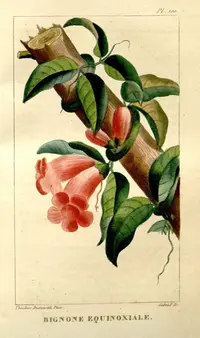
Bignonia aequinoctialis is a vigorous, woody climbing vine known for its clusters of showy, tubular flowers and dense green foliage. It uses tendrils to cling to supports such as trellises, fences, or arbors, forming a thick vertical screen over time.
This species occurs naturally in tropical regions of Central and South America, where it grows in warm, humid conditions with ample rainfall. In cultivation, it suits frost-free climates and is best placed in a sunny to lightly shaded spot with well-drained soil.
Gardeners who want to care for Bignonia aequinoctialis should be aware that its fast growth and need for support structures can require regular training and pruning, but it rewards with abundant, ornamental blooms when conditions are suitable.

Care Difficulty
Moderate Care

Light Preference
Full Sun

Water Requirements
Moderate Water

Temperature Preference
Tropical / Frost Sensitive

Hardiness Zone
10–11

Soil Texture
Sandy, Loamy, Organic-rich

Soil pH
Acidic (5.5–6.5), Slightly acidic (6.5–7.0)

Soil Drainage
Moist but well-drained

Fertilization
Light (every 4–6 weeks)
Scan your plant to receive care tips personalized for your specific plant
Available on iOS and Android
This vigorous climber needs abundant sun to flower well while tolerating some light shade.
This fast-growing vine prefers evenly moist, well-drained soil rather than constant wetness.
This tropical vine grows best in warm, frost-free conditions with only moderate temperature swings.
This vigorous vine benefits from moderately humid air but copes with a range of household conditions.
This species prefers a loose, aerated substrate that drains quickly yet retains some moisture.
This vine can adapt well to container growing when given stable support and room for roots to spread.
Nutrient-rich but well-drained soil supports strong flowering in Bignonia aequinoctialis.
Pruning helps manage the vigorous growth and flowering performance of Bignonia aequinoctialis.
This strong climber is usually grown in-ground, so focus on careful transplanting rather than frequent repotting.
Gardeners most often propagate this vine from cuttings to keep the same flower and growth traits.
This tropical vine is frost-tender and needs protection in regions with cold winters.

Plant Health Check
Not sure what's wrong with your plant? Check your plant's health inside the app.
The species epithet aequinoctialis refers to its occurrence near the equatorial region, reflecting its native distribution in tropical Central and South America close to the equator.
This liana climbs using forked tendrils that coil around supports, an adaptation that allows it to reach forest canopies while keeping its stems relatively slender.
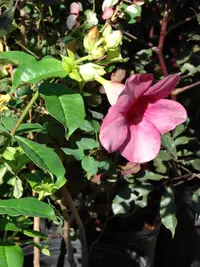
Its elongated, tubular, pink to lavender flowers form narrow nectar tubes that are well matched to the beaks and tongues of hummingbirds, which act as primary pollinators in its native range.

In some parts of its native range, this vigorous woody vine can form dense curtains over trees and shrubs, significantly altering light availability in the understory and creating distinct microhabitats for shade-adapted organisms.
Growth is usually fast in warm climates, often extending 1–2 m per year once established. Rate depends on sun exposure, soil fertility, water, and temperature. Cooler regions or containers generally slow growth noticeably.
Keep your plants happy and healthy with plant identification, disease detection, and easy care guidance.