


Host tree monitoring
Inspect beech trunks and large branches at least twice a year for cracks, sunscald, borer holes, or drought dieback, because stressed wood greatly increases the speed and extent of Biscogniauxia nummularia spread.

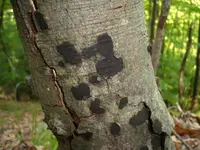
Beech tarcrust, Biscogniauxia nummularia, is not a typical garden plant but a wood-decay fungus that grows on dead or stressed beech wood. It forms flat, black, crust-like patches tightly attached to the bark, giving branches a tar-coated look.
This fungus is common in temperate beech woodlands across Europe and parts of North America, where it plays a role in breaking down dead wood. In gardens or small woodlots, it may signal underlying stress in beech trees rather than being grown deliberately, so how to care for Beech Tarcrust is usually not a concern.
It thrives in cool, damp habitats on suitable host wood and does not need traditional soil, light, or watering conditions like vascular plants.

Care Difficulty
Moderate Care

Light Preference
Partial Shade

Water Requirements
Moderate Water

Temperature Preference
Cool Climate

Hardiness Zone
Unknown

Soil Texture
Loamy, Silty, Organic-rich

Soil pH
Slightly acidic (6.5–7.0)

Soil Drainage
Moist but well-drained

Fertilization
Minimal (feed rarely)
Scan your plant to receive care tips personalized for your specific plant
Available on iOS and Android
This fungus develops naturally on beech wood in shaded to semi-shaded forest conditions with limited direct sun exposure.
This wood-inhabiting fungus relies on the natural moisture balance of beech trunks or fallen branches rather than direct watering.
This species is adapted to temperate woodland climates with cool to mild conditions across the year.
Humidity is not a key factor for Biscogniauxia nummularia, which typically develops on outdoor beech wood in ambient conditions.
This fungus develops naturally on dead or stressed beech wood rather than in conventional soil, so soil preparation focuses on recreating suitable woody substrate conditions.
This species is not suitable for conventional container growing, as it is a wood-decay fungus dependent on beech timber rather than potting media.
This fungus lives on beech wood and does not need fertilization in typical woodland or log-culture conditions.
Pruning is not applicable for Biscogniauxia nummularia, since it is a wood-inhabiting fungus rather than a managed garden plant.
Transplanting focuses on moving colonized wood rather than handling the fungus as a potted plant.
Propagation for this species is not normally attempted in home or garden settings because it spreads naturally via spores on suitable beech wood.
No special winter care is required, as this fungus is adapted to temperate outdoor conditions on dead beech wood.

Plant Health Check
Not sure what's wrong with your plant? Check your plant's health inside the app.
This fungus is strongly associated with European beech and is considered a secondary pathogen, usually exploiting trees already weakened by drought, root damage, or other stress rather than attacking healthy beech outright.
Mature fruiting bodies form a black, tarry crust on dead beech bark that is dotted with tiny, pale gray circular discs, which are the exposed tops of the spore-producing structures.
It contributes to white rot in beech wood by breaking down lignin, the tough structural polymer in cell walls, which helps return locked-up nutrients from dead trees to the forest soil.

Molecular studies have shown that this species, once placed in the large and heterogeneous genus Hypoxylon, is distinct enough in its microscopic features and DNA sequences to be classified in the separate genus Biscogniauxia, illustrating how modern mycology relies heavily on genetic data to refine fungal taxonomy.
This fungus spreads slowly through stressed or dying beech wood, forming black crust-like patches on bark. It does not leap between healthy trees quickly, but can gradually colonize large areas of weakened wood over several years.
Keep your plants happy and healthy with plant identification, disease detection, and easy care guidance.

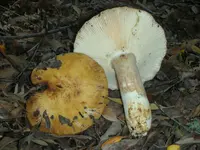
Almond-scented Russula
Russula fragrantissima
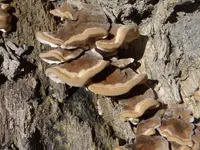
Big Smoky Bracket
Bjerkandera fumosa
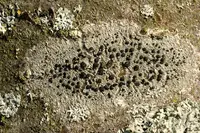
disc lichen
Buellia disciformis
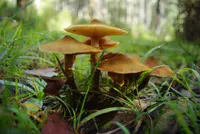
Australian honey fungus
Armillaria luteobubalina
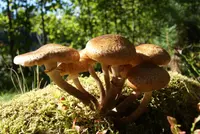
northern honey fungus
Armillaria borealis
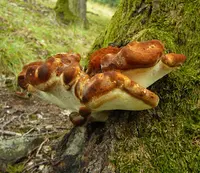
Oak polypore
Buglossoporus quercinus
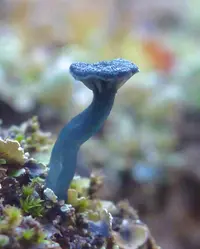
Verdigris Navel
Arrhenia chlorocyanea
Arrhenia spathulata
Arrhenia spathulata