Microhabitat Misting
Use a fine mister to lightly moisten only the immediate moss or leaf-litter surface around the fruiting bodies, avoiding direct spraying on the caps to limit physical damage and reduce fungal disease risk.

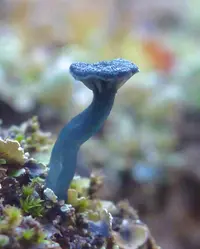
Verdigris navel, Arrhenia chlorocyanea, is a small, greenish-blue agaric fungus rather than a typical leafy houseplant. It forms thin, often irregular caps with a striking bluish to turquoise tint that can fade with age.
This species usually grows on mossy ground, lawns, or among short grass, especially in nutrient-poor or managed turf in temperate regions. It is mainly valued for its unusual color and is not commonly cultivated.
Because it is a specialized fungus with specific habitat needs, it is not an easy choice for beginners who want to care for Verdigris Navel. Successful growth usually depends on recreating its natural moss-rich environment and stable outdoor-like conditions.

Care Difficulty
Hard Care

Light Preference
Shade

Water Requirements
Keep Soil Moist

Temperature Preference
Cool Climate

Hardiness Zone
Unknown

Soil Texture
Organic-rich, Peaty, Loamy

Soil pH
Acidic (5.5–6.5)

Soil Drainage
Moist but well-drained

Fertilization
Minimal (feed rarely)
Scan your plant to receive care tips personalized for your specific plant
Available on iOS and Android
This small fungus prefers cool, low to moderate light similar to shady woodland edges.
Arrhenia chlorocyanea needs consistently moist, not waterlogged, conditions around its organic substrate.
This species prefers cool, moist conditions and declines in sustained heat or hard frost.
This fungal species prefers consistently moist, humid microhabitats rather than dry indoor air.
Arrhenia chlorocyanea is a moss-associated fungus that relies on specific surface conditions rather than conventional potting soil.
This species is only marginally suitable for container growing and is best treated as an experimental moss-and-fungus display.
Arrhenia chlorocyanea, often called Verdigris Navel, is not usually fertilized, as it is a saprotrophic fungus relying on decaying organic matter rather than added nutrients.
Pruning is not part of normal care for Arrhenia chlorocyanea, since it is a small, short-lived mushroom that completes its life cycle quickly.
Transplanting Arrhenia chlorocyanea is rarely successful, as the fungus depends on a specific relationship with its substrate and surrounding micro-organisms.
Propagation of Arrhenia chlorocyanea by home growers is uncommon and technically demanding, as it relies on microscopic spores and specialized substrates.
Specific winter care is not needed for Arrhenia chlorocyanea in climates where it naturally occurs, as the underground mycelium tolerates normal seasonal cold.

Plant Health Check
Not sure what's wrong with your plant? Check your plant's health inside the app.
This fungus produces striking blue to blue‑green fruiting bodies due to pigments concentrated in its thin cap and stem, making it one of the more visually distinctive small agarics in mossy habitats.
It commonly fruits among mosses in grasslands and heathlands, and studies suggest a close ecological association with bryophytes, which likely influences where and when it appears.
The species is recorded from parts of Europe, North America, and Australasia, yet tends to occur in scattered, localized populations rather than as a dominant mushroom in its ecosystems.

Microscopic examination shows that this species has smooth, inamyloid spores, meaning its spores do not change color in iodine-based staining reagents, a diagnostic trait used by mycologists to help distinguish it from similar blue fungi.
This small fungus is not considered a culinary species. It is usually classified as inedible due to its tiny size, insubstantial flesh, and lack of culinary value. It should not be harvested for food purposes.
Keep your plants happy and healthy with plant identification, disease detection, and easy care guidance.