

Use Suitable Substrate
Grow white maze polypore on clean, freshly cut hardwood logs or well-pasteurized hardwood sawdust blocks, avoiding softwoods and resinous woods that slow or inhibit colonization.

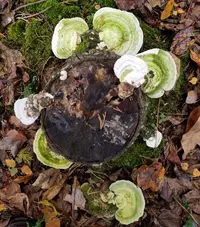
White maze polypore, Trametes elegans, is a wood-decay fungus rather than a typical green plant. It forms thin, fan-shaped brackets on dead or dying hardwood, often layered in overlapping shelves. The pore surface shows a distinctive maze-like pattern, which gives this species its common name.
It occurs mainly in warm, humid forests, especially in tropical and subtropical regions. In cultivation, it is usually grown on sterilized hardwood logs or blocks. Once established, it tends to be resilient, but it needs stable moisture and good air movement. Basic knowledge of how to care for white maze polypore is helpful because it reacts quickly to very dry or stale conditions.

Care Difficulty
Moderate Care

Light Preference
Partial Shade

Water Requirements
Keep Soil Moist

Temperature Preference
Tropical / Frost Sensitive

Hardiness Zone
Unknown

Soil Texture
Loamy, Organic-rich

Soil pH
Acidic (5.5–6.5)

Soil Drainage
Moist but well-drained

Fertilization
Minimal (feed rarely)
Scan your plant to receive care tips personalized for your specific plant
Available on iOS and Android
This wood-decaying fungus prefers low to moderate light levels similar to a shaded forest floor.
Moisture management focuses on keeping the woody substrate consistently damp but never waterlogged.
This species thrives in mild, temperate conditions and declines with hard frost or extreme heat.
This wood-decaying fungus prefers consistently moist, humid conditions rather than dry air.
Trametes elegans does not grow in traditional soil and instead colonizes woody, lignin-rich substrates.
This species can be grown in containers such as bags, buckets, or tubs filled with woody substrate rather than soil.
Trametes elegans grows on decaying wood and usually needs no added fertilizer when the substrate is nutrient rich.
Trametes elegans does not need structured pruning, but limited cleanup supports hygiene and observation.
This bracket fungus is typically grown on logs or sterilized blocks, so care focuses on renewing substrate rather than classic repotting.
Propagation of Trametes elegans is usually done by fungal culture rather than by typical plant methods.
Outdoor Trametes elegans fruiting bodies tolerate cool to cold conditions and generally require minimal winter care.

Plant Health Check
Not sure what's wrong with your plant? Check your plant's health inside the app.
The underside of Trametes elegans fruiting bodies forms a pale, labyrinth-like pore layer instead of round pores, which is why it is often called the white maze polypore.
This species is a white-rot fungus that breaks down lignin in dead hardwoods, leaving the wood lighter in color and more fibrous as it recycles nutrients back into forest ecosystems.
Trametes elegans occurs mainly in tropical and subtropical regions across the Americas, Africa, and parts of Asia, where warm, humid conditions favor its growth on fallen logs and branches.

Some strains of Trametes elegans have been studied for their ability to degrade synthetic dyes and other industrial pollutants in laboratory settings, making this fungus a candidate for future bioremediation research.
This fungus is generally described as inedible due to its tough, leathery texture, not because it is strongly toxic. It is sometimes studied for medicinal compounds, but consumption should be avoided unless guided by a qualified mycologist.
Keep your plants happy and healthy with plant identification, disease detection, and easy care guidance.

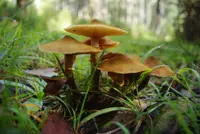
Australian honey fungus
Armillaria luteobubalina
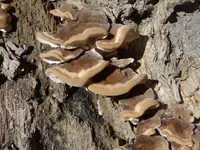
Big Smoky Bracket
Bjerkandera fumosa
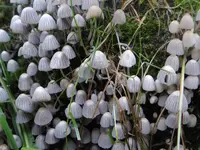
Trooping Crumble Cap
Coprinellus disseminatus

salmon gum mushroom
Phlebopus marginatus

oak pin
Cudoniella acicularis

Fishbiscuit Russula
Russula compacta
redleg jellybelly
Cudonia circinans
Bristly Tropical Cup
Cookeina tricholoma