


Use natural substrates
Grow the fungus on well-soaked, decayed hardwood sticks or palm stems placed on top of the main substrate, which mimics its natural habitat and encourages more reliable cup formation.

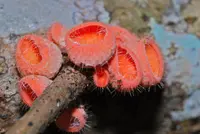
Bristly tropical cup, Cookeina tricholoma, is a small cup fungus rather than a leafy houseplant. It forms bright pink to orange, shallow cup-shaped fruiting bodies on decaying wood. Fine bristles along the rim give it a distinctive, delicate look. It usually appears in clustered groups after rains.
This species is native to humid tropical forests in Central and South America and parts of Asia, where it helps break down dead plant material. In cultivation it is uncommon and considered challenging, as it needs constant moisture, warmth, and very high humidity. Hobbyists who want to care for Bristly Tropical Cup must usually recreate a controlled, terrarium-like environment with consistently damp, wood-based substrate.

Care Difficulty
Hard Care

Light Preference
Shade

Water Requirements
Keep Soil Moist

Temperature Preference
Tropical / Frost Sensitive

Hardiness Zone
Unknown

Soil Texture
Loamy, Silty, Organic-rich

Soil pH
Strongly acidic (4.5–5.5), Acidic (5.5–6.5)

Soil Drainage
Waterlogged tolerant

Fertilization
Minimal (feed rarely)
Scan your plant to receive care tips personalized for your specific plant
Available on iOS and Android
This cup fungus prefers soft, forest-like light rather than direct, open sun exposure.
This fungus requires consistently moist conditions that mimic damp forest floor habitats.
This species thrives in warm, humid conditions typical of lowland tropical forests.
This fungus needs consistently high humidity to form and maintain healthy cups.
This species fruits best on a loose, moisture-retentive but aerated organic substrate rather than true mineral soil.
This species can be grown in shallow containers that hold a stable, moist organic substrate for fruiting.
This saprophytic fungus usually does not need fertilization when grown on decaying wood in suitable forest-like conditions.
Cookeina tricholoma does not require intentional pruning, since individual fruiting cups are short-lived and naturally replaced.
This species is rarely grown in containers; management focuses on relocating or refreshing its decaying wood substrate rather than classic repotting.
Propagation of this cup fungus is typically left to natural spore dispersal and is not straightforward for casual growers.
In mild, frost-free to lightly frosty climates, outdoor colonies generally need no special winter care beyond stable habitat.

Plant Health Check
Not sure what's wrong with your plant? Check your plant's health inside the app.
Its tiny cups act as splash cups: when raindrops hit the inner surface, they catapult spores outward, helping the fungus spread efficiently in dense, wet forest understories.
The vivid orange to pinkish coloration comes from carotenoid pigments, which protect tissues from intense tropical light and ultraviolet radiation while also making the cups highly visible for spore-dispersing splash events.
This species typically grows on very decayed, waterlogged wood in humid tropical forests, indicating advanced stages of wood decomposition and consistently high moisture in its microhabitat.

The cup shape of this fungus is so stable and distinctive that it has been used as a model in mycological field guides to teach beginners how to recognize so-called splash-cup fungi in tropical ecosystems.
This fungus is considered non-toxic and sometimes described as edible, but it is thin, gelatinous, and not widely valued as food. Identification errors with similar cup fungi are possible, so foraging is not recommended for beginners.
Keep your plants happy and healthy with plant identification, disease detection, and easy care guidance.

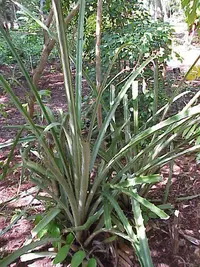
Bromelia karatas
Bromelia karatas
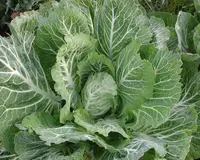
Cabbage
Brassica oleracea var. costata
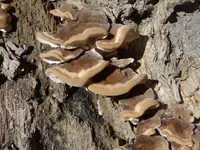
Big Smoky Bracket
Bjerkandera fumosa
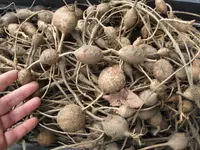
American groundnut
Apios americana
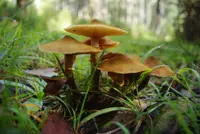
Australian honey fungus
Armillaria luteobubalina
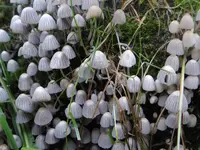
Trooping Crumble Cap
Coprinellus disseminatus
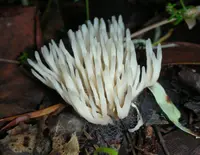
ashen coral
Tremellodendropsis tuberosa
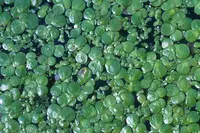
greater duckweed
Spirodela polyrhiza