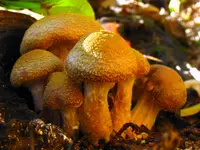
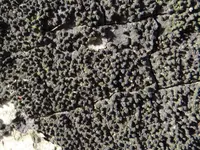
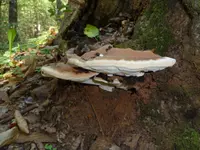
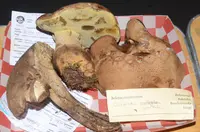
Smoky polypore Care (Bjerkandera adusta)

Also known as: big smoky bracket, Smoky Bracket
Smoky polypore

About Smoky polypore

Smoky polypore (Bjerkandera adusta) is a saprophytic bracket fungus, not a leafy houseplant. It forms thin, overlapping shelves with gray to dark brown tops and white pore surfaces underneath. These fruiting bodies usually grow on dead or decaying hardwood, especially beech and birch. It plays an important role in forests by breaking down lignin, a tough component of wood. In nature it prefers cool, moist, shaded habitats with plenty of rotting wood. For those who want to care for Smoky polypore in cultivation, success depends on providing the right wood substrate and stable, humid conditions rather than typical potting soil or bright light.

Main Plant Requirements

Care Difficulty

Moderate Care

Light Preference

Shade

Water Requirements

Keep Soil Moist

Temperature Preference

Cold Hardy

Hardiness Zone

Unknown

Soil Texture

Loamy, Organic-rich

Soil pH

Acidic (5.5–6.5), Slightly acidic (6.5–7.0)

Soil Drainage

Moist but well-drained

Fertilization

Minimal (feed rarely)

Get Personalized Care Plan

Scan your plant to receive care tips personalized for your specific plant

Available on iOS and Android

How to Care for the Smoky polypore

This wood-decay fungus prefers shaded forest conditions rather than direct open sun.

  • Provide bright dappled shade or full shade with only brief early-morning sun, roughly 1–3 hours, filtered through canopy or structures.
  • Avoid strong midday and afternoon sun, which can dry host wood quickly and slow Smoky polypore development or cause fruiting bodies to crack and fade.
  • In summer, increased canopy shade is usually sufficient; in winter, if leaves drop, protect logs from prolonged direct sun using leaf litter, shade cloth, or placement on the north side of structures.

This fungus depends on consistently moist but not waterlogged wood rather than direct watering.

  • Aim for host logs or stumps that stay evenly moist; surface wood should feel damp but not slimy, and standing water should drain away within a few hours.
  • Before adding water, check 2–3 cm into the wood or surrounding soil; if it feels dry or very light, irrigate gently to re-moisten, especially during dry spells.
  • Reduce supplemental moisture in cool, wet seasons to limit soggy, anaerobic conditions, which encourage competing molds and can slow Bjerkandera adusta colonization.

This species is adapted to cool to mild climates and tolerates a fairly wide temperature range.

  • Optimal wood decay and fruiting generally occur around 50–70°F (10–21°C), with steady moisture and shelter from drying winds.
  • Growth usually continues, though more slowly, from about 40–75°F (4–24°C); short dips near 32°F (0°C) are tolerated, but hard, prolonged frost can damage exposed fruiting bodies.
  • High summer heat above 80–86°F (27–30°C) combined with dry air can halt activity; place host wood in shade and maintain moisture to buffer temperature swings.

Humidity is not a major factor for Bjerkandera adusta, which naturally tolerates wide outdoor moisture conditions.

This wood-decaying fungus grows on dead hardwood rather than in conventional potting soil, but a substrate can be prepared for cultivation.

  • Use a coarse, organic-rich substrate based on hardwood sawdust or small wood chips mixed with 10–20% wheat bran or similar supplement.
  • Keep the substrate evenly moist but not waterlogged by ensuring excess water can drain away or evaporate between soakings.
  • Aim for a slightly acidic to neutral environment, roughly pH 5.5–7.0, which supports stable breakdown of the lignin-rich wood material.
  • Avoid dense garden soil, peat-only mixes, or substrates with fine clay that hold water and restrict air movement around the developing mycelium.

This species is suitable for container growing only in log or bag culture rather than decorative pots.

  • Use sturdy plastic grow bags or buckets with side holes so fresh air reaches the colonized substrate throughout its depth.
  • Stand containers off the ground on slats or bricks to allow air circulation and prevent prolonged contact with puddled water.
  • Secure or brace tall log-filled containers to prevent tipping once fruiting bodies form on one side and shift the weight distribution.

Bjerkandera adusta is a saprophytic wood-decay fungus that normally requires no added fertilizer when growing on suitably rich dead wood.

Pruning is not a standard practice for Bjerkandera adusta, which naturally forms tiered brackets on dead wood without structural training.

  • If removal is needed, cut off brackets at the base with a clean, sharp knife or pruning saw.
  • Best timing is late fall or winter when fruiting bodies are older and spore release has mostly finished.
  • Target only dead, damaged, or unwanted brackets to reduce spore load or improve appearance on ornamentals.

Transplanting for Bjerkandera adusta focuses on moving colonized wood rather than handling traditional roots or pots.

  • Shift colonized logs or stumps in cool, moist weather to reduce desiccation stress on the fungal mycelium.
  • Move only well-colonized pieces of wood, avoiding excessive cutting or splitting that dries internal tissues.
  • Place wood in a shaded, humid site with good air flow and stable moisture to support ongoing fungal activity.
  • Disturb the colonized substrate as little as possible and keep it off bare, sun-heated surfaces to limit thermal shock.

Propagation of Bjerkandera adusta is mainly done through spores or transfer of colonized wood rather than typical plant methods.

  • For controlled culture, introduce spores or mycelium to fresh hardwood logs or blocks with clean drill holes or surface cuts.
  • Best season is spring to early summer, when outdoor temperatures and humidity support rapid mycelial establishment.
  • Keep inoculated wood shaded and evenly moist, avoiding waterlogging to allow oxygen around the developing mycelium.
  • Leave colonized pieces undisturbed for many months, as bracket formation follows full internal colonization of the wood.

This fungus is cold hardy in most temperate climates and generally needs no special winter care when established on outdoor dead wood.

  • Allow natural snow or leaf litter to act as a light insulating layer over colonized wood in very exposed sites.
  • Avoid moving or splitting colonized logs during freezing weather to limit mechanical damage to the mycelium.

Care Tips

Select Proper Substrate

Use freshly cut, non-treated hardwood logs or chips from species like beech, birch, or maple, as Bjerkandera adusta colonizes clean, undecayed wood far more reliably than old, partially decomposed pieces.

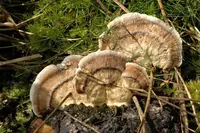
Pre-Condition the Wood

Stack logs or chips in a shaded, airy location for 2–4 weeks before inoculation so surface moisture stabilizes and bark dries slightly, which reduces competitor molds while keeping the wood interior moist.

Clean Inoculation Technique

Disinfect drill bits and tools with 70% isopropyl alcohol before making inoculation holes and work on a clean surface to minimize contamination from aggressive molds and other fungi.

Control Competing Fungi

Inspect colonized wood regularly and promptly remove any sections showing brightly colored molds or unfamiliar fruiting bodies, trimming back to clean white mycelium to maintain a dominant Bjerkandera culture.

Optimize Fruiting Humidity

Once fruiting bodies appear, use a simple plastic tent or humidity tunnel with side vents over the substrate to keep a moist microclimate around the brackets while still allowing enough airflow to prevent bacterial rot when growing Smoky polypore.

Common Pests and Diseases

White rot decay

This disease causes a progressive white, stringy decay of hardwoods that the fungus colonizes, often leaving the wood soft and spongy. Symptoms include bleaching of wood, loss of structural strength, and thin, smoky-gray fruiting brackets on the surface.

Solution

Manage by removing and safely disposing of heavily decayed branches, logs, or landscape timbers and replacing them if structural integrity is needed. For trees used as ornamentals or near structures, have an arborist assess safety and remove or reduce infected, unstable sections to prevent breakage.

Saprobe competition

This condition occurs when other wood-decay fungi outcompete B. adusta on the same log or stump, reducing its colonization and fruiting. Symptoms include mixed patches of different bracket fungi, inconsistent fruiting, and rapid replacement of the usual thin gray shelves by other species.

Solution

If the goal is growing Smoky polypore for observation or study, reduce competition by using fresh, uncolonized hardwood, cutting away sections already infected by other fungi, and storing logs off soil contact to limit introduction of rival decay fungi. Maintain moderate, stable moisture in the wood without prolonged waterlogging to favor consistent colonization.

Wood-boring beetles

These insects tunnel through colonized logs and stumps, feeding on decayed wood and sometimes on fungal tissue, which can damage fruiting bodies. Symptoms include small round exit holes, fine wood dust, and fragmented or partially eaten brackets.

Solution

Manage by removing and destroying heavily infested wood, storing culture logs off the ground on racks, and keeping them in a dry but shaded location that is less attractive to beetles. For valuable display pieces, occasional brushing and physical removal of larvae when galleries are exposed can reduce damage without chemicals.

Interesting Facts

Smoky pore surface

The fruiting body develops a pale gray to dark gray pore surface that often darkens to nearly black with age, giving rise to the common name smoky polypore.

Efficient wood decomposer

This fungus causes a white rot on dead hardwoods, breaking down both lignin and cellulose and playing an important role in nutrient recycling in temperate forests.

Pollution-tolerant species

It frequently colonizes urban and roadside wood, and studies have shown it can tolerate and sometimes transform certain industrial pollutants such as polycyclic aromatic hydrocarbons.

Botan icon

Did you know?

Laboratory research has demonstrated that its enzyme system can decolorize and degrade a range of synthetic dyes, making it a model organism for studying fungal bioremediation of textile wastewater.

FAQs about Smoky polypore

Growth is relatively slow to moderate. Once established in suitable moist, decaying hardwood, brackets typically expand a few millimeters per day, forming noticeable shelves over several weeks, then persisting and slowly enlarging across multiple seasons as decomposition progresses.

Grow Healthy Plants with Botan Care

Keep your plants happy and healthy with plant identification, disease detection, and easy care guidance.

Botan plant care app — identify plants on mobile

Explore More Plants