Select proper host
Establish cultures on freshly cut, disease-free hardwood logs or stumps, since compromised or highly decayed hosts can harbor competing fungi that quickly outgrow artist's bracket.

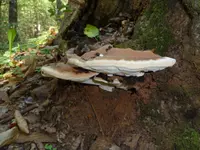
Artist's bracket, Ganoderma applanatum, is a perennial bracket fungus, not a leafy plant. It forms hard, shelf-like structures on dead or decaying wood. The upper surface is usually brown and zoned, while the white underside bruises brown, which has historically allowed artists to etch designs on it. This fungus is widespread in temperate forests across North America, Europe, and parts of Asia, where it acts as a wood decomposer. It is not easy to cultivate intentionally because it depends on specific wood types and decay conditions. Anyone wanting to learn how to care for artist's bracket should understand that it prefers stable moisture, shaded conditions, and well-decayed hardwood logs.

Care Difficulty
Moderate Care

Light Preference
Partial Shade

Water Requirements
Keep Soil Moist

Temperature Preference
Cool Climate

Hardiness Zone
4–9

Soil Texture
Loamy, Silty, Organic-rich

Soil pH
Acidic (5.5–6.5), Slightly acidic (6.5–7.0)

Soil Drainage
Moist but well-drained

Fertilization
Minimal (feed rarely)
Scan your plant to receive care tips personalized for your specific plant
Available on iOS and Android
This wood-decay fungus prefers stable, shaded light conditions rather than direct sun exposure.
Moist, not waterlogged, wood is the key moisture source for this bracket fungus.
This species is adapted to cool to mild woodland climates with broad seasonal variation.
This bracket fungus does not rely on air humidity but on consistently moist wood substrate.
In cultivation, this wood-decay fungus is best grown on dense, woody, organic material rather than typical garden soil.
This species is not well suited to conventional container growing, since it naturally fruits from colonized logs or stumps rather than potting media.
This wood-decay fungus grows on nutrient-rich trees and generally does not need added fertilizer, even in artist's bracket indoor care experiments.
Ganoderma applanatum is not pruned in the usual horticultural sense, since brackets are fungal fruiting bodies on host trees.
This species naturally establishes in wood and is rarely managed through repotting, but transplant-style moves can be done for research or culture blocks.
Propagation of Ganoderma applanatum is specialized and usually handled by experienced growers or researchers rather than casual gardeners.
This bracket fungus is cold hardy across much of its range and typically needs no special winter care when established on outdoor wood.

Plant Health Check
Not sure what's wrong with your plant? Check your plant's health inside the app.
The tough, pale pore surface of this bracket fungus bruises dark brown when scratched, which has led artists to etch detailed images into fresh fruiting bodies that can remain visible for decades when dried.
This species causes a white rot in hardwoods, breaking down both lignin and cellulose and often producing large, shelf-like brackets on the same dead or living tree year after year from the same underlying mycelium.
Its underside typically has several pores per millimeter, forming tiny tubes that release spores in massive numbers, giving mature brackets a dusting of brown spore powder on surfaces below in still forest air.

Individual fruiting bodies of this species can remain attached and visible on a tree or log for multiple years, accumulating annual growth layers that allow mycologists to estimate their age much like counting tree rings.
This fungus grows slowly but persistently, adding new layers each year. Brackets may expand a few cm annually, gradually forming thick, semicircular shelves that can persist for many years on the same trunk or log.
Keep your plants happy and healthy with plant identification, disease detection, and easy care guidance.