Host tree management
Maintain healthy beech trees by avoiding root compaction, heavy trunk damage, and unnecessary soil disturbance, since this ectomycorrhizal fungus depends on vigorous host roots to fruit reliably.

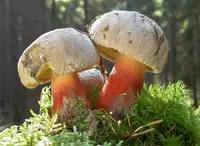
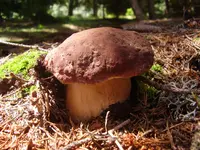
Bitter beech bolete, Caloboletus calopus, is a wild ectomycorrhizal mushroom, not a typical houseplant. It forms a symbiotic relationship with tree roots, especially beech and other broadleaf trees. The fruiting bodies have a pale to yellow cap, a striking red to pinkish stem base, and yellow pores that often bruise blue when handled. This species is strongly bitter and considered inedible, which affects how to care for Bitter Beech Bolete in managed woodland or outdoor settings. It naturally occurs in temperate forests across Europe and parts of North America, appearing on the ground in leaf litter. Successful growth depends on suitable host trees, undisturbed soil, and stable moisture rather than conventional pot or garden culture.

Care Difficulty
Hard Care

Light Preference
Partial Shade

Water Requirements
Keep Soil Moist

Temperature Preference
Cool Climate

Hardiness Zone
Unknown

Soil Texture
Loamy, Organic-rich

Soil pH
Acidic (5.5–6.5)

Soil Drainage
Moist but well-drained

Fertilization
Minimal (feed rarely)
Scan your plant to receive care tips personalized for your specific plant
Available on iOS and Android
This ectomycorrhizal fungus prefers cool, shaded forest conditions rather than direct open sun.
This woodland fungus relies on consistently moist, but not waterlogged, soil around its tree partners.
This species favors cool to mild woodland temperatures and is sensitive to both hard frost and intense heat.
Humidity is not a meaningful care factor for this wild ectomycorrhizal fungus, so specific humidity management is unnecessary for Bitter Beech Bolete.
This ectomycorrhizal fungus depends on specific outdoor forest soil conditions rather than prepared potting substrates.
This species is not suitable for container growing, as it requires a stable symbiosis with tree roots in undisturbed forest soil.
Caloboletus calopus is a wild mycorrhizal fungus that normally does not need direct fertilization when associated with healthy host trees.
Caloboletus calopus is not pruned, as it is a wild ectomycorrhizal fungus rather than a managed garden plant.
This fungus is typically left undisturbed in natural soil with its host trees, so transplanting is rarely appropriate or successful.
Propagation of Caloboletus calopus is specialized and usually left to natural spore dispersal and mycorrhizal formation in the field.
In natural woodland settings this species is fully cold hardy and needs no active winter care.

Plant Health Check
Not sure what's wrong with your plant? Check your plant's health inside the app.
This bolete is strongly bitter, and even small amounts can spoil mixed mushroom dishes, which is why it is considered inedible despite not being classified as deadly poisonous.
The whitish to pale yellow flesh turns blue rapidly when cut or bruised due to oxidation of pigment compounds, a reaction common in some boletes but very pronounced in this species.
It forms ectomycorrhizal associations with beech and other broadleaf trees in temperate forests, exchanging mineral nutrients from the soil for sugars produced by the tree through photosynthesis, which is a key aspect of Caloboletus calopus care instructions in natural habitats.

The striking red-and-yellow stipe with a fine net-like pattern, combined with the greyish cap and rapid blue staining, makes this species one of the more easily recognized boletes in European and North American beech forests, and it often serves as a textbook example in mushroom identification guides.
This species is technically non-lethal but is considered inedible due to its very bitter taste and potential to cause digestive upset. It is best treated as a non-edible wild fungus and left unharvested.
Keep your plants happy and healthy with plant identification, disease detection, and easy care guidance.