Use Suitable Substrate
Grow fruiting bodies on well-decayed moss cushions, peat-rich turf, or old shaded brick or wood with existing bryophyte cover, rather than bare soil or bark, since this fungus is strongly associated with moss substrates.

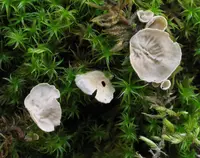
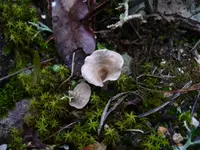
Small moss oysterling, Arrhenia retiruga, is a tiny, short-lived mushroom rather than a traditional houseplant. It forms delicate, shell-like caps on thin stems, usually only a few millimeters across. The fruiting bodies often appear on mossy soil, rotting plant material, or damp forest floors in temperate regions of Europe and North America.
This fungus has a subtle, grayish to brownish color that blends into moss and leaf litter, making it easy to overlook. It is considered difficult to cultivate intentionally, as it relies on specific moss-rich, consistently moist microhabitats. Anyone trying to care for Small Moss Oysterling should focus on stable humidity and gentle, indirect light similar to a damp woodland floor.

Care Difficulty
Hard Care

Light Preference
Shade

Water Requirements
Keep Soil Moist

Temperature Preference
Cool Climate

Hardiness Zone
Unknown

Soil Texture
Peaty, Organic-rich

Soil pH
Strongly acidic (4.5–5.5)

Soil Drainage
Moist but well-drained

Fertilization
Minimal (feed rarely)
Scan your plant to receive care tips personalized for your specific plant
Available on iOS and Android
This small saprotrophic fungus prefers cool, gentle light similar to a shaded forest floor.
This fungus relies on consistently moist, well-aerated substrate rather than direct watering of its fruiting bodies.
This species fruits best in cool to mild conditions typical of temperate forests.
This small fungus prefers consistently moist, humid microhabitats rather than dry indoor air.
This species grows on decomposing plant material rather than conventional garden soil.
This species can be kept in shallow containers or trays that mimic a thin, consistently moist forest-floor layer.
This small, wood-inhabiting fungus grows on nutrient-poor mossy substrates and usually needs no supplemental feeding when left in natural conditions.
Arrhenia retiruga is a delicate wild fungus with no practical pruning needs in typical cultivation or observation settings.
This fungus is not managed like a potted plant, but its substrate can be refreshed when grown for observation or study.
Reproducing Arrhenia retiruga is specialized work and is rarely attempted outside research or advanced hobby contexts.
This is a hardy, cold-adapted fungus that normally requires no specific winter care in outdoor, naturalistic setups.

Plant Health Check
Not sure what's wrong with your plant? Check your plant's health inside the app.
This small basidiomycete typically fruits directly on living or dead moss cushions, especially Bryum and similar genera, rather than on soil or wood, making it strongly tied to bryophyte communities.
Its pale, fan-shaped caps show thin, widely spaced, often forked gills that can be strongly veined and run down the stem, reflecting adaptation to very small fruiting bodies on uneven moss surfaces.
In much of Europe and similar temperate regions it appears mainly in autumn to winter, when mosses are moist and actively growing, indicating a preference for cool, wet microclimates.

Molecular studies have shown that Arrhenia retiruga and related moss-associated fungi are not closely related to typical woodland agarics, leading to significant reclassification within the Hygrophoraceae as DNA data clarified their distinct evolutionary lineages.
This fungus spreads modestly where suitable moss or liverwort hosts are present. It fruits in small, scattered clusters rather than dense carpets, and typically does not overrun garden spaces or containers under normal conditions.
Keep your plants happy and healthy with plant identification, disease detection, and easy care guidance.