

Spore-safe handling
Wear disposable gloves and avoid inhaling dust when cutting or breaking old fruiting bodies, as dried spores can be irritants and should be bagged and discarded with household trash instead of composted.

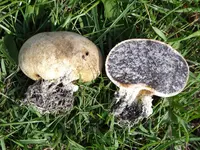
The potato earthball, Scleroderma bovista, is a small, underground fungus rather than a leafy plant. It forms firm, round, potato-like balls with thick, rough skin. As it matures, the outer layer cracks and releases dark brown spores.
This species occurs mainly in woodlands, heathlands, and sandy soils, often near trees in temperate regions. It is not a typical choice for home cultivation, and attempts to care for Potato Earthball are challenging because it relies on complex relationships with soil and tree roots.
In nature it favors well-drained, slightly poor soils and appears in spots with moderate light and consistent natural moisture.

Care Difficulty
Moderate Care

Light Preference
Partial Shade

Water Requirements
Moderate Water

Temperature Preference
Cool Climate

Hardiness Zone
Unknown

Soil Texture
Sandy, Loamy, Rocky

Soil pH
Acidic (5.5–6.5), Slightly acidic (6.5–7.0)

Soil Drainage
Well-drained

Fertilization
Minimal (feed rarely)
Scan your plant to receive care tips personalized for your specific plant
Available on iOS and Android
This soil-dwelling fungus prefers bright, indirect conditions with some daily sun but protection from harsh exposure.
This fungus prefers evenly moist, well-drained soil and is sensitive to prolonged saturation.
This species is adapted to temperate conditions and tolerates a moderate range of outdoor temperatures.
Humidity is not a key factor for Scleroderma bovista, which tolerates a wide range of ambient moisture.
This ectomycorrhizal fungus prefers loose, well-aerated, free-draining mineral soils with modest organic content.
This species is generally unsuitable for long-term container cultivation, as it relies on symbiosis with tree roots in open soil.
This wild ectomycorrhizal fungus generally does not need fertilizing when grown in suitable, undisturbed soil.
Scleroderma bovista does not require structured pruning, since the visible fruiting bodies are temporary and naturally break down.
Transplanting is rarely necessary, as this fungus forms long-term partnerships with host tree roots in stable soil.
Reproduction of this species is mainly left to natural spore dispersal and is not a typical home propagation project.
This ground-dwelling fungus is naturally cold hardy and usually needs no special winter protection in the landscape, even in snowy climates.

Plant Health Check
Not sure what's wrong with your plant? Check your plant's health inside the app.
The outer surface forms a thick, tough, yellow to brown skin covered in coarse warts, which protects the internal spore mass from drying and mechanical damage in exposed sandy habitats.
Instead of forming gills or pores, it develops a single dense spore mass (gleba) that turns dark brown to almost black as it matures and then escapes through cracks and ruptures in the outer skin.
This species frequently appears on nutrient-poor, sandy or disturbed soils such as paths, roadsides, and open grasslands, indicating a high tolerance for low organic matter and compacted substrates.

Molecular studies and field observations have shown that Scleroderma bovista can form ectomycorrhizal associations with trees, creating a mutualistic relationship in which the fungus improves root nutrient and water uptake while receiving carbohydrates from the host.
This fungus is considered poisonous and should not be eaten by humans or animals. Ingestion can cause stomach upset and more serious symptoms. Teach children not to handle or taste unfamiliar puffballs or earthballs.
Keep your plants happy and healthy with plant identification, disease detection, and easy care guidance.

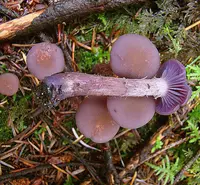
Western Amethyst Laccaria
Laccaria amethysteo-occidentalis
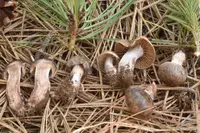
spring webcap
Cortinarius vernus
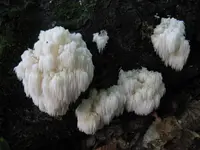
Bear's Head Tooth
Hericium americanum
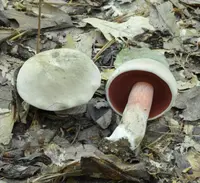
Caloboletus firmus
Caloboletus firmus
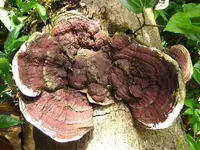
Earliella scabrosa
Earliella scabrosa
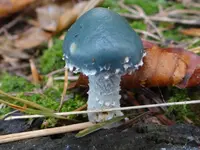
Blue Roundhead
Stropharia caerulea
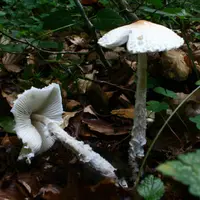
Shield Dapperling
Lepiota clypeolaria
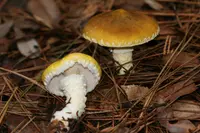
Floccularia albolanaripes
Floccularia albolanaripes