Use host logs
Establish the fungus on partially buried, fresh hardwood logs (oak, beech, maple) placed in shaded, moist ground, as the decaying wood provides a stable long-term food source and helps control spread into living trees.

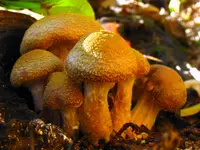
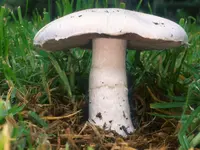
Bulbous honey fungus, Armillaria gallica, is a wood-decaying fungus rather than a typical houseplant. It forms clusters of honey-colored to brown caps with a slightly bulbous stem base. The fungus grows from underground rhizomorphs, which are dark, cord-like structures that spread through soil and infected wood.
It occurs naturally in temperate forests across North America, Europe, and parts of Asia, usually on stumps, buried roots, or weakened trees. This species is hardy and persistent, which makes it easy to maintain once established but also difficult to remove from infected sites.
It generally prefers cool conditions, consistent moisture, and organic-rich, decaying wood rather than regular potting soil, which affects how to care for Bulbous Honey Fungus in cultivation.

Care Difficulty
Hard Care

Light Preference
Partial Shade

Water Requirements
Regular Water

Temperature Preference
Cold Hardy

Hardiness Zone
4–9

Soil Texture
Loamy, Clay, Organic-rich

Soil pH
Acidic (5.5–6.5), Slightly acidic (6.5–7.0)

Soil Drainage
Moist but well-drained

Fertilization
Minimal (feed rarely)
Scan your plant to receive care tips personalized for your specific plant
Available on iOS and Android
This wood-decaying fungus prefers moderate, stable woodland light conditions rather than full exposure.
This fungus thrives in consistently moist but not waterlogged wood and soil around host roots.
This temperate-climate fungus grows best in cool to mild outdoor conditions.
This wood-decaying fungus tolerates a broad humidity range but fruits best in consistently moist air.
Armillaria gallica naturally colonizes woody substrates and mineral soil, so substrate preparation should mimic decaying forest litter.
This species is not well suited to conventional container growing, which rarely supports its extensive underground network.
Armillaria gallica usually feeds on woody material and does not need routine fertilization in natural settings or outdoor culture.
Armillaria gallica itself is not pruned; management focuses on host plants and infected wood rather than shaping the fungus.
This fungus is seldom grown in pots; management relates more to where it appears than to moving established colonies.
Intentional home propagation of this wood-decaying fungus is uncommon and generally not recommended in garden settings.
This species is naturally cold hardy, so Bulbous Honey Fungus typically needs no deliberate winter care in outdoor environments.

Plant Health Check
Not sure what's wrong with your plant? Check your plant's health inside the app.
The underground mycelium of this species can produce a faint greenish light, a phenomenon known as foxfire that is caused by enzymatic reactions involving luciferin-like compounds.
Individual genetic clones of this fungus can spread through soil and colonize many tree roots, forming single organisms that extend over large areas while remaining genetically uniform.
This species usually behaves as a weak pathogen, often attacking trees that are already stressed, and contributes to forest dynamics by accelerating the death and decay of compromised hosts.

A single Armillaria gallica clone in Michigan was once estimated, based on field mapping and genetic studies, to be at least 1,500 years old and to cover several tens of hectares, making it one of the largest and oldest known fungal individuals on Earth.
This species spreads very aggressively through underground rhizomorphs and infected wood. It can move several meters per year, killing or weakening trees and shrubs. In managed landscapes it is usually considered a serious root-rot pathogen, not an ornamental organism.
Keep your plants happy and healthy with plant identification, disease detection, and easy care guidance.