Use hardwood chips
Establish outdoor beds on partially decomposed hardwood chips or mixed leaf litter rather than fresh sawdust, as this provides a stable substrate that supports steady colonization and fruiting.

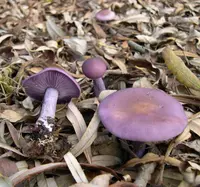
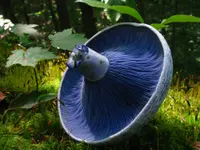
Blewit, Lepista nuda, is a cool-season saprotrophic mushroom that breaks down leaf litter and other organic debris in forests and gardens. It forms sturdy, thick stems with smooth lilac to violet caps that often fade to brown as they mature.
This species typically appears in leaf litter of deciduous woodlands, grassy edges, and compost-rich areas in temperate regions. It often fruits in clusters during autumn and early winter.
Most growers consider it moderately easy to cultivate if given rich, moist organic matter and consistent cool conditions. Understanding how to care for Blewit starts with providing clean substrate and stable moisture rather than complex equipment.

Care Difficulty
Moderate Care

Light Preference
Partial Shade

Water Requirements
Keep Soil Moist

Temperature Preference
Cool Climate

Hardiness Zone
Unknown

Soil Texture
Loamy, Silty, Organic-rich

Soil pH
Acidic (5.5–6.5), Slightly acidic (6.5–7.0)

Soil Drainage
Moist but well-drained

Fertilization
Minimal (feed rarely)
Scan your plant to receive care tips personalized for your specific plant
Available on iOS and Android
This saprotrophic mushroom prefers cool, dappled woodland-style light rather than intense direct sun.
This woodland fungus needs consistently moist, not saturated, substrate to form reliable fruiting bodies.
This cool-season mushroom fruits best under mild to chilly outdoor conditions.
This saprophytic fungus benefits from moderately moist air during active growth but does not need tightly controlled humidity.
Lepista nuda thrives in loose, organic-rich substrate that stays evenly moist yet drains freely.
This species can be grown in containers outdoors if the vessel is large and holds a deep, breathable substrate layer.
Lepista nuda, a saprophytic fungus, relies mainly on decaying organic matter, so direct fertilization is usually unnecessary.
Pruning is not relevant for Lepista nuda, since it is a mushroom-forming fungus without woody stems or foliage.
Transplanting Lepista nuda focuses on moving colonized substrate or mycelium rather than handling a typical potted plant.
Propagation of Lepista nuda is usually done by spreading mycelium rather than by traditional plant methods.
Lepista nuda is generally cold hardy in temperate climates and usually needs minimal winter care outdoors.

Plant Health Check
Not sure what's wrong with your plant? Check your plant's health inside the app.
The characteristic lilac to violet color of its gills and cap comes from water-soluble pigments that can fade or almost disappear with age, frost, or cooking, which sometimes makes field identification harder in older specimens.
This species typically fruits in late autumn to early winter in temperate regions, often appearing after the first frosts when many other fleshy fungi have already disappeared.
Lepista nuda is a saprotrophic fungus, meaning it feeds on dead organic matter such as leaf litter and woody debris, helping recycle nutrients back into forest soils and supporting overall woodland ecosystem function.

In some European countries, this mushroom has a long culinary history and is considered a choice edible when correctly identified, yet in other regions it is approached cautiously or avoided because its violet color and similarity to toxic species can make confident identification challenging for non-experts.
This mushroom is considered edible when correctly identified and thoroughly cooked, but some people experience digestive upset or allergic reactions. It strongly resembles toxic species, so safe collection requires expert identification and cautious tasting in small amounts first.
Keep your plants happy and healthy with plant identification, disease detection, and easy care guidance.