Manage Root Spread
Install a deep root barrier or plant in a large, contained bed to limit lateral root spread and make future removal or relocation of suckers more manageable when caring for parrotweed.

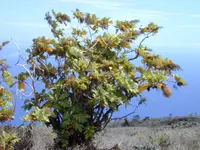
Parrotweed, Bocconia frutescens, is a fast-growing evergreen shrub or small tree known for its large, deeply lobed leaves and airy clusters of tiny orange-brown flowers. It often develops a loose, open canopy and can form thickets in suitable climates.
This species is native to tropical regions of the Americas but has naturalized in some subtropical areas, where it may become invasive. It prefers warm conditions, well-drained soil, and moderate moisture, which generally makes it easy to establish.
Gardeners who want to care for parrotweed should be aware of its vigorous growth and spreading habit, especially in frost-free regions, and plan planting sites accordingly.

Care Difficulty
Moderate Care

Light Preference
Full Sun

Water Requirements
Moderate Water

Temperature Preference
Tropical / Frost Sensitive

Hardiness Zone
10–13

Soil Texture
Sandy, Loamy, Organic-rich

Soil pH
Acidic (5.5–6.5), Slightly acidic (6.5–7.0)

Soil Drainage
Moist but well-drained

Fertilization
Minimal (feed rarely)
Scan your plant to receive care tips personalized for your specific plant
Available on iOS and Android
This fast-growing shrub prefers bright outdoor conditions with some protection from extreme sun.
This species prefers evenly moist but not saturated soil, especially during its establishment phase.
This plant thrives in warm, frost-free climates and reacts poorly to prolonged cold.
This species handles a broad humidity range but grows best with moderate ambient moisture.
This species prefers deep, well-aerated soil that drains freely yet retains some moisture.
This large, vigorous shrub is only moderately suited to container growing and needs careful management.
Bocconia frutescens grows vigorously in average soil and only needs modest feeding for container or nutrient-poor sites when caring for parrotweed.
Pruning Bocconia frutescens helps control size, maintain structure, and remove weak growth in gardens where it can be vigorous.
This species is usually grown in the ground, so most attention focuses on careful transplanting rather than frequent repotting.
Bocconia frutescens is commonly propagated by seed and sometimes by semi-ripe cuttings where controlled spread is desired.
In mild, frost-free climates Bocconia frutescens needs little winter care, but light protection helps in marginal areas.

Plant Health Check
Not sure what's wrong with your plant? Check your plant's health inside the app.
This species produces tall, plume-like inflorescences with many small, apetalous flowers, meaning the flowers lack petals and show their colored stamens instead, giving a hazy, smoky appearance at a distance.
The shrub develops thick, hollow stems that are relatively brittle, which helps it resprout quickly from the base after physical damage such as pruning or storm breakage.
In parts of Hawaii, Florida, and some Caribbean islands, this plant forms dense thickets in disturbed and secondary forests, shading out native understory plants and altering natural forest regeneration patterns.

Birds are strongly attracted to its orange capsules and dark seeds, and this bird-mediated seed dispersal has been linked directly to the rapid spread of the species into remote forest areas far from original planting sites.
This species spreads vigorously by both seed and suckering roots, especially in warm, frost-free climates. In many regions it is classified as invasive and can outcompete native vegetation, so planting is often discouraged and sometimes regulated.
Keep your plants happy and healthy with plant identification, disease detection, and easy care guidance.