Host tree selection
Establish this mycorrhizal fungus near compatible host trees such as oaks or pines, and avoid disturbing established root zones so the underground network can develop and fruit consistently.

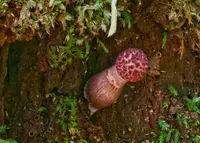
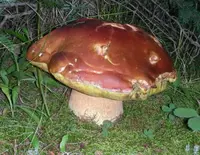
Shaggy cap, Boletellus emodensis, is a mycorrhizal mushroom that grows in association with tree roots rather than as a typical houseplant or garden perennial. It usually forms small groups on soil or leaf litter in forests, often near pines or other conifers.
The cap is distinctly shaggy or fibrous, with warm brown to reddish tones, and the stem is often slightly rough or scaly. This species appears seasonally and is not easily maintained in containers or standard beds.
Because it depends on a living tree partner and specific soil fungi, it is considered challenging to cultivate deliberately. Most people simply observe it in suitable woodland conditions rather than trying to care for shaggy cap at home.

Care Difficulty
Moderate Care

Light Preference
Partial Shade

Water Requirements
Regular Water

Temperature Preference
Warm Climate

Hardiness Zone
Unknown

Soil Texture
Loamy, Sandy, Organic-rich

Soil pH
Acidic (5.5–6.5)

Soil Drainage
Moist but well-drained

Fertilization
Minimal (feed rarely)
Scan your plant to receive care tips personalized for your specific plant
Available on iOS and Android
This mycorrhizal fungus prefers dappled woodland light with moderate, indirect sun exposure.
Moist, well-drained forest soil is essential for stable development of Boletellus emodensis.
This species favors mild to warm conditions and declines quickly in temperature extremes.
This mushroom-forming species does best in consistently moist, high-humidity conditions near the ground surface.
Boletellus emodensis associates with tree roots and requires a loose, well-aerated, organic-rich substrate rather than conventional potting soil.
This ectomycorrhizal mushroom is not well suited to long-term container culture, since it depends on stable partnerships with tree roots in open ground.
Boletellus emodensis typically partners with tree roots and needs minimal direct fertilization.
Pruning is generally not applicable to Boletellus emodensis, as it is a mycorrhizal fungus rather than a woody or leafy plant.
Transplanting focuses on the associated host tree or soil rather than the fungus itself.
Propagation of Boletellus emodensis is rarely controlled directly and relies mainly on natural spore spread and maintaining suitable host trees.
Specific winter care for Boletellus emodensis is usually unnecessary because it survives in soil and fruiting is seasonal.

Plant Health Check
Not sure what's wrong with your plant? Check your plant's health inside the app.
The cap surface forms thick, tufted scales with uplifted edges, giving it a distinctly shaggy appearance that is unusual among boletes and helps separate it from smoother-capped relatives.
When cut or bruised, the yellowish flesh and pores typically stain reddish or wine-colored, a diagnostic feature used by field mycologists to confirm identification.
This species forms ectomycorrhizal associations with pine roots, exchanging mineral nutrients and water from the soil for sugars produced by the tree through photosynthesis.

The spores of this species have conspicuous longitudinal ridges visible under a microscope, a distinctive ornamentation pattern that helps mycologists recognize it among other boletes.
This fungus grows best outdoors in soil or woody debris where it can form mycorrhizal partnerships with tree roots. Indoors, it is very difficult to maintain the right microbes, airflow, and substrate depth for reliable development.
Keep your plants happy and healthy with plant identification, disease detection, and easy care guidance.