Substrate replacement
After spores are released and the puffball collapses, remove and discard the spent fruiting body and the top 1–2 in of surrounding substrate to reduce buildup of competing fungi and bacteria before the next crop forms.

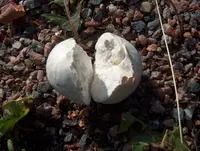
Dusty puffball, Bovista nigrescens, is a small saprobic fungus, not a leafy houseplant. It grows as firm, round, whitish balls that turn brown and release dark spores when mature. In nature it is found in grasslands, lawns, pastures, and open soil, especially in temperate regions.
This species lives on decaying organic matter and does not form roots, stems, or leaves. It is sometimes cultivated for curiosity or educational displays, but it is not a typical ornamental. Because it depends on specific moisture, substrate, and fungal conditions, it is usually easier to observe in the wild than to care for Dusty Puffball indoors.
When encouraged in gardens, it tends to appear in undisturbed, moderately moist, well-drained soil with plenty of organic material and light foot traffic rather than direct tending.

Care Difficulty
Moderate Care

Light Preference
Partial Shade

Water Requirements
Moderate Water

Temperature Preference
Cool Climate

Hardiness Zone
Unknown

Soil Texture
Loamy, Sandy, Organic-rich

Soil pH
Slightly acidic (6.5–7.0), Neutral (7.0)

Soil Drainage
Well-drained

Fertilization
Minimal (feed rarely)
Scan your plant to receive care tips personalized for your specific plant
Available on iOS and Android
This grassland puffball prefers open sites with moderate, not extreme, sun exposure.
This fungus relies on stable, moderately dry soil conditions rather than frequent surface wetting.
This species is adapted to temperate climates with moderate seasonal temperature shifts.
Humidity is not a critical factor for Bovista nigrescens, which naturally grows in open, breezy habitats.
This species prefers open, well-aerated ground that stays free-draining after rain.
This species is generally unsuitable for long-term container growing because it is a soil-dwelling fungus dependent on complex ground conditions.
This wild puffball is adapted to nutrient-poor soils and usually needs no fertilizer in gardens or naturalized areas.
Pruning needs for Bovista nigrescens are minimal and relate mainly to site tidiness rather than plant health.
This species is not suited to typical container culture, so management focuses on careful transplanting or relocation of colonized soil.
Propagation of Bovista nigrescens is mainly by spores and is usually left to natural processes rather than controlled methods.
This hardy puffball usually needs no special winter care in typical temperate climates.

Plant Health Check
Not sure what's wrong with your plant? Check your plant's health inside the app.
The fruiting body starts pale and gradually turns dark brown to almost black as it matures, a color change linked to spore maturation and exposure to light and air.
Unlike many small puffballs, this species develops a relatively thick, tough outer layer (peridium) that helps the dried fruiting body persist and continue releasing spores over time.
It is frequently found in short grassland, pastures, and lawns on moderately nutrient-rich soils, often forming scattered groups in areas that are regularly mown or grazed.

Molecular studies have confirmed that this species, long known only from its macroscopic appearance, fits firmly within the true puffball lineage in the family Agaricaceae, helping clarify relationships among several superficially similar Bovista species.
Young, firm fruiting bodies with pure white flesh inside are considered edible in some regions. Once the interior turns yellow, olive, or brown, it should not be eaten. Correct identification is essential, as some similar puffballs or look-alikes are unsafe.
Keep your plants happy and healthy with plant identification, disease detection, and easy care guidance.