

Retain Moist Microhabitat
Leave a thin layer of short grass, moss, or leaf litter around existing caps to maintain the cool, slightly moist surface conditions that favor growing verdigris waxcap in pasture or lawn settings.

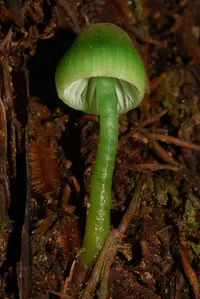
The verdigris waxcap, Gliophorus viridis, is a small, grassland mushroom rather than a leafy plant. It typically appears with a slender stem and a slimy, translucent green cap. In the field it often grows scattered or in small groups among short mossy grass, especially in unimproved, low-nutrient lawns and meadows. It is native to temperate regions, including parts of Europe and North America, but can be quite localized. This fungus is considered sensitive to disturbance and chemical use, which makes it challenging to cultivate deliberately. Gardeners who care for verdigris waxcap usually focus on maintaining low-fertility, undisturbed turf with consistent moisture and good soil structure.

Care Difficulty
Hard Care

Light Preference
Partial Shade

Water Requirements
Keep Soil Moist

Temperature Preference
Cool Climate

Hardiness Zone
Unknown

Soil Texture
Loamy, Silty, Organic-rich

Soil pH
Strongly acidic (4.5–5.5), Acidic (5.5–6.5)

Soil Drainage
Moist but well-drained

Fertilization
Minimal (feed rarely)
Scan your plant to receive care tips personalized for your specific plant
Available on iOS and Android
This woodland fungus prefers low, filtered light rather than direct sun exposure.
This fungus depends on consistently moist, but not waterlogged, soil to form healthy fruiting bodies.
This species fruits best in cool, moist conditions typical of autumn grasslands and light woodland.
This species is a woodland fungus that needs consistently moist, humid conditions around 70–90% to fruit well.
Gliophorus viridis develops best in cool, consistently moist, organic-rich grassland or woodland soils.
This species is not suitable for container growing because its mycelium relies on complex soil and grassland ecosystems that pots cannot replicate.
Gliophorus viridis is a wild, nutrient-efficient fungus that generally should not be fertilized in garden or container settings.
Gliophorus viridis does not require conventional pruning because it is a small mushroom rather than a leafy plant.
This species is rarely suited to containers, so care focuses on minimal disturbance when establishing or moving habitat patches.
Practical home propagation of Gliophorus viridis is difficult because it depends on complex soil and grassland conditions.
In suitable climates, verdigris waxcap is naturally cold hardy and needs no special winter care beyond maintaining stable habitat.

Plant Health Check
Not sure what's wrong with your plant? Check your plant's health inside the app.
The caps and stems of this waxcap contain green pigments that remain visible even when wet, giving the fruiting bodies a translucent, verdigris-like appearance uncommon among grassland fungi.
This species is typically found in unimproved, low-fertility grasslands and mossy lawns, and its presence is often used by mycologists as an indicator of long-established, low-input grassland habitat.
The cap and stem surface are both distinctly slimy when fresh, and the gills have a waxy consistency, a combination of traits that helps separate it from similar greenish agaric fungi in the field.
This fungus is generally regarded as inedible or of no culinary value. It is small, slimy, and offers poor texture. Identification mistakes with similar species can be risky, so it is best left unharvested.
Keep your plants happy and healthy with plant identification, disease detection, and easy care guidance.

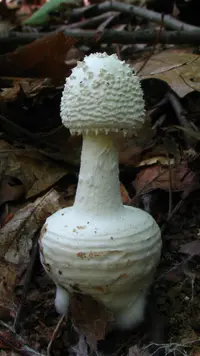
American Abrupt-Bulbed Lepidella
Amanita abrupta
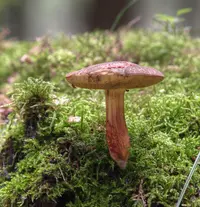
Red-cracking Bolete
Xerocomellus chrysenteron
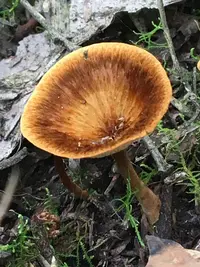
Coltricia australica
Coltricia australica
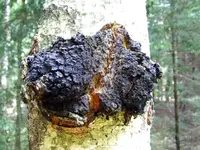
chaga
Inonotus obliquus
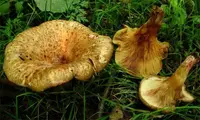
alder roll-rim
Paxillus filamentosus
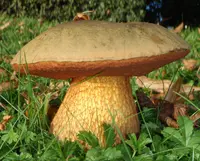
Lurid Bolete
Suillellus luridus
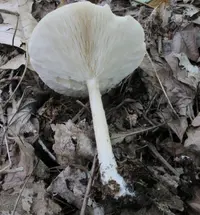
Collybia alboflavida
Collybia alboflavida
ringless honey fungus
Desarmillaria tabescens