


Host tree selection
Establish this mycorrhizal fungus with healthy young alder or related host trees, since it depends on their roots for nutrients and will not perform well without a compatible partner.

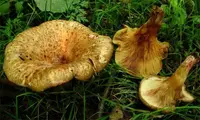
Alder roll-rim, Paxillus filamentosus, is a gilled mushroom-forming fungus, not a leafy houseplant. It forms brown to yellowish funnel-shaped caps with rolled, inrolled margins and crowded gills that often bruise darker. Fruiting bodies typically appear near alder trees in moist woodlands and along forest edges, where it grows in soil rich in decaying organic matter.
This species forms close associations with tree roots and depends on natural woodland conditions, so it is not an easy subject for casual cultivation. Those who attempt to care for alder roll-rim must understand that it behaves more like a forest mushroom than a garden plant and needs stable moisture, shade, and undisturbed, humus-rich soil.

Care Difficulty
Moderate Care

Light Preference
Partial Shade

Water Requirements
Keep Soil Moist

Temperature Preference
Cool Climate

Hardiness Zone
Unknown

Soil Texture
Loamy, Silty, Organic-rich

Soil pH
Acidic (5.5–6.5), Slightly acidic (6.5–7.0)

Soil Drainage
Moist but well-drained

Fertilization
Minimal (feed rarely)
Scan your plant to receive care tips personalized for your specific plant
Available on iOS and Android
Paxillus filamentosus, commonly called alder roll-rim, develops fruiting bodies best in cool, bright woodland shade rather than direct open sun.
Paxillus filamentosus relies on consistently moist, not waterlogged, soil around its alder hosts to support fungal growth and fruiting.
This fungus fruits best in cool to mild conditions typical of temperate woodlands.
Humidity is not a key factor for Paxillus filamentosus compared with moisture in its substrate.
Paxillus filamentosus develops best in consistently moist, loose mineral soil rich in decaying organic matter.
This species is not suitable for container growing, because it depends on stable outdoor soil and tree-root associations rather than isolated pot culture.
This fungus is typically associated with alder roots in natural soil and does not require supplemental fertilizer in cultivation.
Paxillus filamentosus is not maintained as a pruned ornamental, so no structured pruning regime is recommended.
In the rare case of managed culture, this mycorrhizal fungus is best left undisturbed once established with its host tree.
Propagation of this mycorrhizal species is specialized and not recommended for typical home cultivation or edible use.
Native populations generally tolerate typical outdoor winter conditions in their range and need no specific winter care.

Plant Health Check
Not sure what's wrong with your plant? Check your plant's health inside the app.
This species is strongly associated with alder trees (Alnus spp.), forming ectomycorrhizal partnerships where its fine root-like hyphae surround tree roots and help them access nutrients in exchange for sugars.
Like its close relative Paxillus involutus, this fungus can trigger severe immune-mediated hemolysis in humans, where repeated exposure to its toxins causes the body to destroy red blood cells, making it unsafe to eat even if cooked.
The fruiting bodies release a brown spore print, a key diagnostic feature that helps distinguish it from some superficially similar agaric mushrooms with pale or white spore prints.

The gills of this species are characteristically decurrent, meaning they run clearly down the stem, and they often stain brown when bruised or handled, a field feature that mycologists use together with its alder association to separate it from look-alike mushrooms in mixed forests.
This mushroom is strongly toxic and potentially deadly, even after thorough cooking. It can trigger severe immune-mediated hemolytic anemia and kidney damage. Pets and humans must never eat it, and handling should be cautious and limited.
Keep your plants happy and healthy with plant identification, disease detection, and easy care guidance.

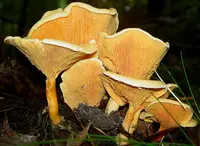
False Chanterelle
Hygrophoropsis aurantiaca
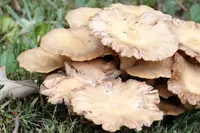
ringless honey fungus
Desarmillaria tabescens
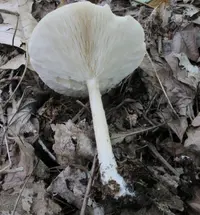
Collybia alboflavida
Collybia alboflavida
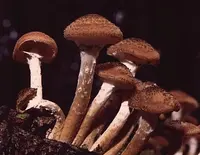
honey mushroom
Armillaria ostoyae
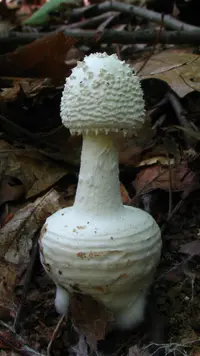
American Abrupt-Bulbed Lepidella
Amanita abrupta
clustered toughshank
Collybiopsis confluens
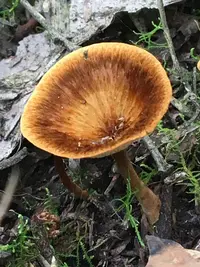
Coltricia australica
Coltricia australica
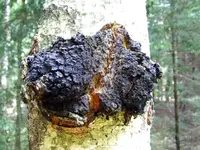
chaga
Inonotus obliquus