Use ash hosts
Establish the fungus in soil near healthy ash trees, ideally in undisturbed turf or mulched areas over fine roots, since this species depends on its association with ash roots and their woolly aphids.

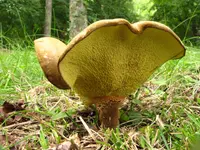
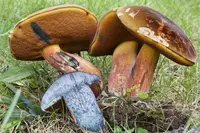
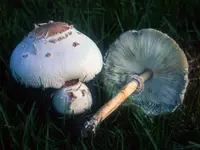
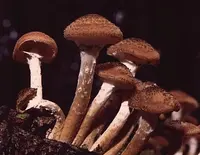
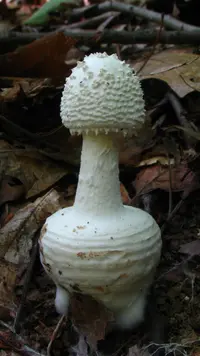
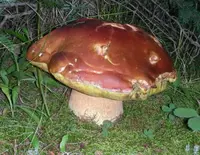
Boletinellus merulioides, commonly called ash-tree bolete, is a mycorrhizal mushroom that forms a partnership with the roots of ash trees. It produces medium to large, yellow-brown caps with a sponge-like pore surface instead of gills.
This fungus is typically found in late summer to fall in North America, especially under green and white ash in parks, yards, and woodland edges. In cultivation, it is challenging because it depends on living ash roots and specific soil fungi.
Anyone wishing to learn how to care for ash-tree bolete should focus on maintaining healthy ash hosts, stable soil conditions, and moderate, even moisture around tree roots.

Care Difficulty
Moderate Care

Light Preference
Partial Shade

Water Requirements
Moderate Water

Temperature Preference
Cool Climate

Hardiness Zone
3–9

Soil Texture
Loamy, Clay, Organic-rich

Soil pH
Slightly acidic (6.5–7.0), Neutral (7.0)

Soil Drainage
Moist but well-drained

Fertilization
Minimal (feed rarely)
Scan your plant to receive care tips personalized for your specific plant
Available on iOS and Android
This fungus develops best in bright, indirect woodland light that mimics dappled shade under ash trees.
Water management focuses on maintaining a consistently moist but not saturated soil environment around the host tree roots.
This species prefers temperate conditions and fruits most reliably in mild late-summer to autumn weather.
Humidity is not a major factor for Boletinellus merulioides, which naturally tolerates variable outdoor conditions.
This fungus develops best in loose, well-drained, organic-rich soil around ash tree roots.
This species is not realistically suitable for container growing because it depends on complex associations with ash tree roots in open ground.
This ectomycorrhizal fungus relies mainly on its ash host and soil nutrients, so added fertilizer is usually unnecessary for ash-tree bolete.
Pruning is not applicable to Boletinellus merulioides, since it is a wild, short-lived mushroom fruiting from underground structures rather than a plant with persistent stems or foliage.
In gardens or experimental settings, focus on establishing suitable ash trees rather than moving the fungus itself.
Propagation of Boletinellus merulioides is specialized and not practical for typical home growers.
This species is cold hardy in its native range and usually needs no special winter care beyond normal ash tree health management.

Plant Health Check
Not sure what's wrong with your plant? Check your plant's health inside the app.
This fungus forms numerous hollow, pea-sized sclerotia around ash tree roots; these hardened structures act as survival organs that allow it to persist through drought or cold when the mushroom itself is absent.
It lives in a unique three-way association with ash trees and the gall-forming aphid Prociphilus fraxinifolii, using the aphid-modified root tissues as a nutrient source rather than forming a typical mycorrhizal partnership with the tree.
In North America it is found mainly under green and white ash, often appearing in scattered groups or arcs at the base of host trees, which makes it an indicator species for ash-dominated habitats.

The cap surface often becomes pitted and irregular with age, giving older specimens a distinctive honeycombed appearance that can make them look quite different from the smooth, young fruiting bodies commonly shown in field guides.
This species is generally considered inedible or of very poor culinary value due to tough texture and mediocre taste. Some sources list it as edible, but it is not recommended for regular consumption or for beginners.
Keep your plants happy and healthy with plant identification, disease detection, and easy care guidance.