Host tree selection
Establish this ectomycorrhizal fungus only with suitable conifer hosts such as pine or spruce, ideally in low-nutrient, well-drained, acidic soils where these trees are already healthy and stable.

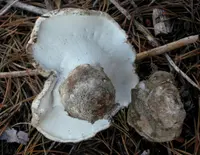
Boletopsis spp., including Boletopsis grisea, are ectomycorrhizal fungi that form a symbiotic relationship with the roots of pine and other conifers. They are not typical houseplants but specialized forest fungi. The fruiting bodies are thick, gray to brown, and leathery, with a porous underside instead of gills. They usually grow on the ground in nutrient-poor, sandy soils of coniferous forests in Europe and North America. These fungi are considered rare and sensitive to habitat disturbance, which makes them challenging to cultivate outside natural conditions. For those studying how to care for Boletopsis spp., it is important to understand their dependence on specific tree partners and undisturbed forest soils.

Care Difficulty
Hard Care

Light Preference
Partial Shade

Water Requirements
Moderate Water

Temperature Preference
Cool Climate

Hardiness Zone
Unknown

Soil Texture
Sandy, Loamy, Organic-rich

Soil pH
Strongly acidic (4.5–5.5)

Soil Drainage
Well-drained

Fertilization
Minimal (feed rarely)
Scan your plant to receive care tips personalized for your specific plant
Available on iOS and Android
This fungus prefers cool, shaded forest conditions rather than direct open sun.
Watering focuses on maintaining an evenly moist, well-drained forest-floor environment.
This species is adapted to cool, temperate forest climates and dislikes prolonged heat.
Humidity has little direct impact on this ectomycorrhizal fungus compared with soil and host-tree conditions.
Boletopsis grisea relies on specific woodland-like soil conditions that are difficult to reproduce in cultivation.
This species is not realistically suitable for container growing, as it depends on complex ectomycorrhizal relationships with living conifer roots that are not stable in pots.
This mycorrhizal fungus grows with conifers and usually does best without added fertilizer in natural or woodland-style plantings of Boletopsis spp.
Boletopsis grisea forms mushroom fruiting bodies and does not require pruning in the usual horticultural sense.
In cultivation, this fungus is managed through its tree host rather than frequent repotting or transplanting.
Propagation of Boletopsis grisea is challenging and rarely attempted outside research contexts, as it depends on complex associations with host tree roots.
This fungus is naturally cold hardy in temperate forests and usually needs no special winter care when associated with an appropriate conifer host.

Plant Health Check
Not sure what's wrong with your plant? Check your plant's health inside the app.
This fungus forms ectomycorrhizal associations with Pinus species, especially Scots pine, exchanging mineral nutrients from the soil for sugars from the tree roots.
It characteristically appears in dry, nutrient-poor, often sandy or podzolic coniferous forests, and is considered a bioindicator of such low-nutrient, relatively undisturbed habitats.
Populations are declining in several European countries due to forestry intensification and habitat loss, and it is red-listed or considered threatened in multiple national fungal conservation assessments.

The spore-bearing surface of this species is covered with short, grayish spines rather than gills or pores, placing it among the so-called tooth fungi, which disperse spores from these downward-pointing projections.
This fungus is considered inedible or of very poor culinary value. Flesh is tough and bitter, with no established tradition of safe consumption. Identification is difficult, so it should not be collected for food.
Keep your plants happy and healthy with plant identification, disease detection, and easy care guidance.