Mycorrhizal host choice
Establish young fungi near compatible conifers such as pine, fir, or spruce, and avoid areas previously heavily limed or disturbed, since stable, lightly acidic forest-type soils support better mycorrhizal formation.

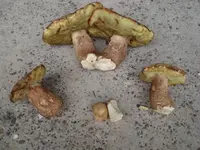
Boletus subcaerulescens is a mycorrhizal fungus, not a leafy houseplant. It forms mutualistic partnerships with the roots of conifer trees, helping both partners access nutrients.
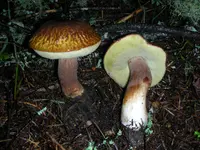
The fruiting body has a thick, pale to yellowish cap, a spongy pore surface, and often shows a subtle blue staining when bruised. It typically appears in mixed or conifer forests in parts of North America.
Because it relies on complex root relationships and natural forest soil, it is difficult to cultivate at home. For most growers, it is more practical to observe and care for Boletus subcaerulescens in its natural woodland environment rather than attempt active cultivation.

Care Difficulty
Hard Care

Light Preference
Partial Shade

Water Requirements
Keep Soil Moist

Temperature Preference
Cool Climate

Hardiness Zone
Unknown

Soil Texture
Loamy, Sandy, Organic-rich

Soil pH
Acidic (5.5–6.5)

Soil Drainage
Moist but well-drained

Fertilization
Minimal (feed rarely)
Scan your plant to receive care tips personalized for your specific plant
Available on iOS and Android
This ectomycorrhizal fungus prefers forest light conditions rather than open, full-sun exposure.
Water management focuses on keeping the forest soil evenly moist without staying saturated.
This species prefers cool to mild conditions typical of coniferous forests.
This ectomycorrhizal fungus requires consistently moist, high-humidity forest conditions and is not suited to dry air culture.
This species fruits only in association with conifer roots, so soil preparation focuses on matching its natural forest substrate.
This species is not realistically suitable for container growing because it depends on complex ectomycorrhizal relationships with mature conifer roots.
This ectomycorrhizal fungus relies mainly on its tree partners for nutrients and usually does not need additional feeding in natural or woodland-style plantings.
Boletus subcaerulescens does not require pruning, since the visible mushroom is a temporary fruiting body rather than a permanent plant structure.
Transplanting focuses on the host tree and its root zone, since this fungus forms underground associations rather than acting as a typical potted plant.
Propagation of Boletus subcaerulescens is technically complex and not typically attempted by home growers, so practical home-scale methods are limited.
This woodland fungus is naturally cold hardy in its native range and generally requires no special winter care in outdoor settings.

Plant Health Check
Not sure what's wrong with your plant? Check your plant's health inside the app.
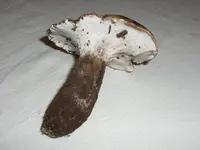
The flesh shows a slow and often uneven blue staining when bruised or cut, which helps distinguish it from some closely related North American boletes that either do not blue or blue much more rapidly.
This species forms ectomycorrhizal partnerships with coniferous trees, especially hemlock and spruce, exchanging mineral nutrients from the soil for sugars produced by the host tree.
It is considered a North American taxon, documented mainly from the northeastern United States and adjacent regions, and is not known as a widespread species on other continents in current literature.
This species is generally considered inedible or at least not recommended for consumption due to limited documentation and possible confusion with toxic boletes. For safety, it is best treated as a non-edible, study-only mushroom.
Keep your plants happy and healthy with plant identification, disease detection, and easy care guidance.