Use host trees
Establish this mycorrhizal fungus near compatible hardwoods such as oaks or hickories, since it depends on living tree roots rather than organic beds or compost piles for reliable fruiting.

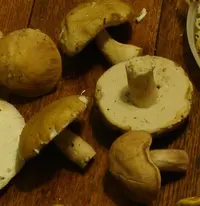
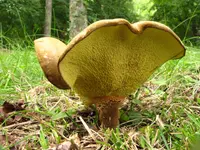
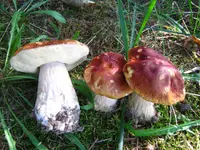
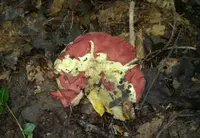
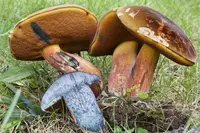
Boletus variipes is a fleshy, pore-bearing mushroom rather than a leafy plant. It forms sturdy, pale to tan caps with a thick, often finely networked stem and a spongy pore surface underneath. This species typically appears in hardwood forests, especially with oaks, across eastern North America. It grows on the ground, forming mycorrhizal partnerships with tree roots, which makes it impossible to cultivate in a typical home setting. Because of this dependence on specific trees and soil fungi, it is considered difficult to grow deliberately. General guides on how to care for Boletus variipes mostly focus on protecting its natural woodland habitat instead of pot or garden culture.

Care Difficulty
Hard Care

Light Preference
Partial Shade

Water Requirements
Keep Soil Moist

Temperature Preference
Cool Climate

Hardiness Zone
Unknown

Soil Texture
Loamy, Silty, Organic-rich

Soil pH
Acidic (5.5–6.5)

Soil Drainage
Moist but well-drained

Fertilization
Minimal (feed rarely)
Scan your plant to receive care tips personalized for your specific plant
Available on iOS and Android
This mycorrhizal mushroom prefers dappled woodland light rather than open sun.
This fungus depends on evenly moist, well-drained forest soil rather than frequent direct watering.
This woodland species fruits best in mild to warm conditions without temperature extremes.
This ectomycorrhizal mushroom relies on soil moisture around tree roots, and ambient humidity matters less than consistent ground dampness.
Boletus variipes depends on specific woodland soil conditions rather than a standard garden bed.
This woodland ectomycorrhizal species is not suitable for container growing because it requires a living tree root system in stable forest soil.
This wild mycorrhizal fungus generally relies on its tree partners for nutrition and needs no direct fertilization.
Boletus variipes is not a plant and does not require pruning in the horticultural sense.
This species is a wild, mycorrhizal bolete that is not suited to normal pot culture or transplanting.
Boletus variipes is typically managed through habitat and host-tree conservation rather than direct propagation by home growers.
This fungus overwinters naturally in the soil as mycelium and normally needs no dedicated winter care from gardeners.

Plant Health Check
Not sure what's wrong with your plant? Check your plant's health inside the app.
This mushroom is recognized by its long, slender stipe covered with fine, net-like ridges (reticulation) that are usually lighter than the surrounding surface, a key feature used by mycologists to separate it from similar bolete species in the eastern United States.
Boletus variipes forms ectomycorrhizal partnerships with the roots of hardwood trees, especially oaks, exchanging mineral nutrients and water for sugars produced by the tree, and typically appears in mixed or oak-dominated woodlands.
Unlike many boletes whose pore surface turns blue when injured, the whitish to pale yellow pores of this species usually show little to no color change when bruised, which helps distinguish it from several look-alike blue-staining boletes.

Molecular phylogenetic studies have shown that Boletus variipes, once grouped broadly with many Boletus species based mainly on appearance, represents a more narrowly defined lineage within the bolete group, and its genetic distinctness has helped clarify the boundaries between several closely related North American bolete taxa.
This species is generally considered an edible wild mushroom when correctly identified, with a mild flavor. However, misidentification with toxic look-alikes is a serious risk, so beginners should not consume it without expert confirmation.
Keep your plants happy and healthy with plant identification, disease detection, and easy care guidance.