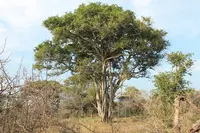
Deep root establishment
During the first 2–3 years, irrigate less often but for longer sessions to encourage a deep rooting system that anchors the palm and improves drought tolerance when growing toddy palm in open ground.


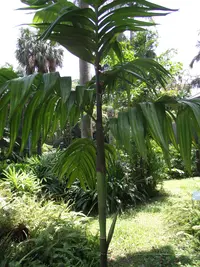
Toddy palm, Borassus flabellifer, is a large, slow-growing fan palm best suited to warm tropical and subtropical climates. It eventually forms a tall, solitary trunk topped with a dense crown of stiff, fan-shaped leaves.
In nature it occurs across South and Southeast Asia, where it is valued for its sap, fruit, and durable timber. Young plants stay trunkless for many years, focusing on strong root and leaf development before vertical growth begins.
The species prefers full sun, warmth, and well-drained soil, and it resents cold, waterlogging, and cramped containers. These traits mean that how to care for toddy palm depends strongly on access to space, consistent heat, and bright light, making it challenging indoors or in cool regions.

Care Difficulty
Hard Care

Light Preference
Full Sun

Water Requirements
Low Water

Temperature Preference
Tropical / Frost Sensitive

Hardiness Zone
10–12

Soil Texture
Sandy, Loamy, Rocky

Soil pH
Slightly acidic (6.5–7.0), Neutral (7.0)

Soil Drainage
Well-drained

Fertilization
Minimal (feed rarely)
Scan your plant to receive care tips personalized for your specific plant
Available on iOS and Android
Borassus flabellifer thrives in strong, direct light and needs open exposure to develop a sturdy trunk and full crown.
Borassus flabellifer prefers deep, infrequent watering once established, with soil allowed to dry somewhat between soakings.
This species is a heat-loving palm that needs warm conditions and is sensitive to frost at all growth stages.
This species handles low humidity well, so humidity management is rarely critical indoors or outdoors.
Borassus flabellifer prefers deep, coarse, fast-draining substrates that still retain moderate moisture.
This palm is not well suited to long-term container culture, though short-term growing of young plants is possible.
This large palm grows slowly and usually needs only moderate feeding in cultivated landscapes.
Pruning Borassus flabellifer focuses on safety and sanitation rather than shaping.
Transplanting is critical for young Borassus flabellifer, as mature palms resent disturbance.
Propagation of this species is almost entirely by seed and is relatively slow.
This tropical palm is sensitive to freezing and needs protection in cooler regions.

Plant Health Check
Not sure what's wrong with your plant? Check your plant's health inside the app.
This palm is dioecious, meaning individual trees are either male or female, and only female trees produce the large, fibrous fruits with edible jelly-like seeds.
The unopened flower stalks can be tapped to collect a sugary sap that is consumed fresh, boiled into palm sugar, or fermented, a practice documented for centuries across South and Southeast Asia.
Its stiff, fan-shaped leaves can reach over 3 m across and have been traditionally used for thatching, basketry, and as a historic writing material in palm-leaf manuscripts.

Individual trees of this species can live for several centuries and form long-lasting cultural landscapes in parts of India and Southeast Asia, where aligned rows of old palms still mark historic routes, field boundaries, and settlement edges.
Yes, this species is usually propagated from fresh seeds. Sow cleaned seeds promptly in deep containers or directly outdoors, keep warm and evenly moist, and expect germination to be slow, often taking several months.
Keep your plants happy and healthy with plant identification, disease detection, and easy care guidance.