Use stable substrates
Attach thalli only to long-lasting, inert substrates such as unglazed stone, old roof tile, or seasoned hardwood, since frequent substrate replacement disrupts colony establishment and slows growing disc lichen.

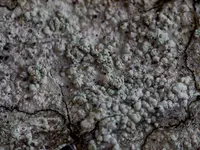
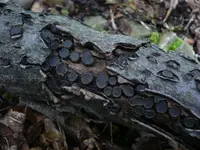
Disc lichen (Buellia griseovirens) is a crustose lichen, not a true plant, formed by a partnership between a fungus and photosynthetic algae. It grows as thin, flat patches tightly attached to bark, wood, or rock, usually gray to greenish with small dark discs where spores are produced. This species is common in temperate regions, especially on tree trunks in woodlands, parks, and old orchards. It grows slowly and prefers stable, undisturbed surfaces with clean air, which makes it sensitive to heavy pollution. For anyone learning how to care for disc lichen, conditions that mimic its natural habitat, with good air flow and moderate light, are most suitable.

Care Difficulty
Moderate Care

Light Preference
Partial Shade

Water Requirements
Low Water

Temperature Preference
Cold Hardy

Hardiness Zone
Unknown

Soil Texture
Rocky, Sandy

Soil pH
Acidic (5.5–6.5)

Soil Drainage
Well-drained

Fertilization
Minimal (feed rarely)
Scan your plant to receive care tips personalized for your specific plant
Available on iOS and Android
This crustose lichen prefers cool, stable light rather than intense direct sun, especially on tree bark or shaded rock.
This lichen absorbs water directly over its surface and prefers natural wet–dry cycles rather than constant moisture.
This species is cold hardy and tolerates a wide temperature span, but growth is most active in cool, moist conditions.
This lichen tolerates a wide humidity range but thrives in consistently moist air.
Buellia griseovirens is a crustose lichen that anchors to firm surfaces rather than growing in typical potting soil.
This species can be grown in shallow containers primarily as a mounted lichen display.
Buellia griseovirens is a crustose lichen that generally does not require supplemental fertilizer in cultivation or in nature.
Pruning is not a routine practice for Buellia griseovirens, since lichens lack true stems and leaves and maintain their form naturally.
This lichen is usually grown on bark, rock, or wood, so focus on relocating its substrate rather than handling the thallus directly.
Intentional propagation of Buellia griseovirens is specialized and slow, so it is rarely attempted outside scientific or conservation work.
This species is cold hardy and, under normal outdoor conditions, needs no special winter care beyond stable host surfaces.

Plant Health Check
Not sure what's wrong with your plant? Check your plant's health inside the app.
This crustose lichen often colonizes roadside and urban trees because it tolerates relatively high levels of atmospheric nitrogen and some air pollutants compared to many more sensitive lichen species.
The thallus forms small, gray to gray-green patches with numerous black, rounded apothecia (fruiting discs) that are slightly raised and usually distinct from the surrounding surface, a key feature used in field identification of this species.
It most frequently occurs on smooth-barked broadleaf trees such as beech and sycamore maple, where its thin, closely attached crust can spread over large sections of trunk and branches without penetrating deeply into the bark.

Chemical analysis has shown that this species produces specific lichen substances detectable by thin-layer chromatography, which lichenologists use to distinguish it from closely related gray crustose species that look very similar to the naked eye.
Growth is very slow. The thallus usually extends only a few millimeters per year, even under good conditions. It invests energy in surviving harsh environments rather than adding size, so visible change can take many years.
Keep your plants happy and healthy with plant identification, disease detection, and easy care guidance.