Mounting for airflow
Mount plants on cork or hardwood with a thin pad of sphagnum so roots dry quickly between waterings and receive excellent air movement, which reduces rot in dense Bulbophyllum root systems.

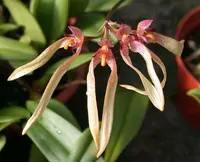
The pale umbrella orchid, Bulbophyllum longiflorum, is a small to medium epiphytic orchid that often grows attached to tree trunks and branches. It forms clumps of pseudobulbs, each carrying a single, narrow leaf.
Its arching flower stems hold many pale, umbrella-like blooms that can appear quite dramatic compared with the compact foliage. This species is native to tropical forests of Africa and nearby islands, where it enjoys warm, humid, shaded conditions.
These natural habits influence how to care for Pale umbrella orchid, as it prefers consistent moisture, good air movement, and bright but indirect light. It is considered moderately demanding, best suited to growers ready to monitor humidity and watering carefully.

Care Difficulty
Hard Care

Light Preference
Partial Shade

Water Requirements
Keep Soil Moist

Temperature Preference
Tropical / Frost Sensitive

Hardiness Zone
12–13

Soil Texture
Peaty, Organic-rich, Loamy

Soil pH
Acidic (5.5–6.5)

Soil Drainage
Moist but well-drained

Fertilization
Moderate (every 2–4 weeks)
Scan your plant to receive care tips personalized for your specific plant
Available on iOS and Android
This orchid prefers bright, gentle light that mimics dappled forest shade.
Bulbophyllum longiflorum prefers consistently moist conditions without staying saturated.
This orchid grows best in warm to intermediate temperatures with stable conditions.
This orchid requires consistently high humidity to maintain healthy foliage and flowering.
This species prefers a very loose, airy, organic substrate rather than dense soil.
This orchid is well suited to container growing in baskets or shallow pots.
Bulbophyllum longiflorum benefits from light, consistent feeding during active growth for steady flowering.
Pruning Bulbophyllum longiflorum is minimal and focuses on hygiene rather than shaping.
Repotting Bulbophyllum longiflorum is infrequent but important to maintain aeration and healthy roots.
Propagation of Bulbophyllum longiflorum is usually done by careful division of mature clumps.
Bulbophyllum longiflorum is not frost tolerant and needs mild, protected conditions through winter.

Plant Health Check
Not sure what's wrong with your plant? Check your plant's health inside the app.
This species produces many small, pale yellow to greenish flowers arranged in a radiating circle on a long, slender stalk, giving an umbrella-like appearance that inspired its common name, pale umbrella orchid.
The flowers emit a faint, often unpleasant odor that mimics decaying material, a strategy that attracts small fly pollinators which mistake the blooms for a potential egg-laying site.
It is naturally widespread across parts of tropical Africa, Madagascar, Sri Lanka, Southeast Asia, and into the Pacific islands, typically growing as an epiphyte on trees in humid forests at low to mid elevations.

This orchid often forms dense, mat-like clumps of small pseudobulbs connected by creeping rhizomes, allowing a single colony to gradually spread over large sections of tree bark in suitable humid forest habitats.
Lack of flowering usually comes from insufficient light, too-warm nights, or skipping a brief drier rest after growth. Overfertilizing with high nitrogen and keeping the plant rootbound for many years can also reduce spike and flower production.
Keep your plants happy and healthy with plant identification, disease detection, and easy care guidance.