Brillantaisia cicatricosa Care

Brillantaisia cicatricosa

About Brillantaisia cicatricosa

Brillantaisia cicatricosa is a shrubby perennial from tropical Africa, grown mainly for its showy purple flowers and textured, often marked leaves. It typically forms a bushy clump with upright stems and a loose, somewhat sprawling habit.

In suitable climates it is used as an ornamental in warm gardens or large containers, valued for its long flowering season and lush foliage. The plant prefers warm conditions, consistent moisture, and fertile, well-drained soil, which influences how to care for Brillantaisia cicatricosa.

Its fast growth and tolerance of pruning make it reasonably manageable for intermediate growers, though cool drafts and prolonged dryness can cause stress or leaf drop.

Main Plant Requirements

Care Difficulty

Moderate Care

Light Preference

Partial Shade

Water Requirements

Keep Soil Moist

Temperature Preference

Tropical / Frost Sensitive

Hardiness Zone

11–12

Soil Texture

Loamy, Silty, Organic-rich

Soil pH

Acidic (5.5–6.5), Slightly acidic (6.5–7.0)

Soil Drainage

Moist but well-drained

Fertilization

Light (every 4–6 weeks)

Get Personalized Care Plan

Scan your plant to receive care tips personalized for your specific plant

Available on iOS and Android

How to Care for the Brillantaisia cicatricosa

This species prefers bright, indirect light with some protection from intense midday sun.

  • Provide 4–6 hours of filtered or dappled sun daily, ideally with gentle morning sun and afternoon shade to reduce leaf scorch risk for Brillantaisia cicatricosa.
  • Grow in partial shade in hotter regions, giving only 2–3 hours of direct early sun; strong sun after 11 a.m. can bleach foliage and dry the soil too fast.
  • In winter, ensure it still receives bright light by avoiding deep shade from buildings or trees, or flowering and growth will decline.

This plant prefers evenly moist, never waterlogged soil throughout the growing season.

  • Water when the top 2–4 cm of soil feel dry, aiming for consistently moist soil during active growth without leaving the root zone saturated.
  • Improve drainage with organic matter in heavier soils; prolonged puddling, foul smell, or yellowing lower leaves indicate overwatering and poor aeration.
  • Reduce watering slightly in cooler seasons, watching for drooping or curling leaves as a sign the soil has dried too far between waterings.

This species performs best in warm, frost-free conditions through the growing season.

  • Aim for 65–80°F (18–27°C) for steady growth; temperatures in this range support flowering and limit stress on foliage and roots.
  • Protect from cold below 50°F (10°C), as tissue damage may begin, and expect serious injury or death near 32°F (0°C) or during any frost event.
  • In hotter periods above 86°F (30°C), provide extra shade and soil moisture, since high heat combined with full sun increases wilting and leaf burn risk.

This species prefers moderately humid air but tolerates typical indoor levels if not extremely dry.

  • Aim for 50–70% humidity, using a pebble tray or room humidifier if indoor air stays below 40%.
  • Crisping leaf edges, downward curling, and stalled growth indicate low humidity stress rather than underwatering.
  • Keep the plant away from heating vents or strong drafts that cause rapid air drying and localized humidity drops.

This plant grows best in loose, moisture-retentive but sharply draining soil.

  • Use a mix of 50–60% peat or coco coir, 20–30% compost, and 20–30% perlite or pumice for structure and aeration.
  • Aim for slightly acidic to neutral pH, around 6.0–7.0, avoiding chalky or strongly alkaline substrates.
  • Ensure water drains through freely within seconds, with no pooling or foul odor that would signal anaerobic, oxygen-poor conditions.
  • Avoid heavy clay, compacted garden soil, and mixes with excessive fine sand that hold water yet limit air around roots.

This species is suitable for container growing when the pot supports its vigorous top growth and root spread.

  • Choose a wide, weighty pot to reduce tipping as stems elongate and become top-heavy in wind or rain.
  • Select slightly porous materials such as unglazed clay if the plant sits in a wet climate, to prevent prolonged waterlogging.
  • Use a deeper container than a standard bedding pot to allow stronger anchoring roots that stabilize tall, leafy stems.

This fast-growing ornamental benefits from moderate feeding to support leafy growth and flowering.

  • Use a balanced liquid fertilizer (around 10-10-10 or 20-20-20) at 1/2 strength for Brillantaisia cicatricosa during active growth.
  • Apply every 3–4 weeks in spring and summer to container plants; in-ground plants often need less frequent feeding.
  • Choose slow-release granules or well-rotted compost for a gentler, longer-lasting nutrient supply.
  • Stop or greatly reduce fertilizing in fall and winter when growth slows, to avoid weak, soft shoots.

Thoughtful pruning keeps this shrub compact, promotes bushy growth, and supports good flowering.

  • Time main pruning for late winter or very early spring before strong new growth starts.
  • Remove dead, damaged, or crossing stems first, using clean, sharp hand pruners for precise cuts.
  • Shorten overly long or leggy shoots to encourage branching and a fuller shape in Brillantaisia cicatricosa.
  • Lightly trim after flowering only if needed, avoiding heavy cuts that remove next season’s buds.

Container-grown plants and young garden specimens benefit from periodic repotting or transplanting to maintain vigorous growth.

  • Check for roots circling the pot, emerging from drainage holes, or noticeably slowed growth as signs repotting is needed.
  • Repot in spring every 2–3 years, moving to a container 2–5 cm wider with fresh, free-draining, humus-rich mix.
  • Water thoroughly before and after shifting the plant, and handle the root ball gently to limit root tearing and shock.
  • For garden transplants, choose mild, frost-free weather, keep as much root and soil together as possible, then water and mulch well.

Brillantaisia cicatricosa is usually propagated from softwood or semi-ripe stem cuttings for consistent results.

  • Take 8–12 cm softwood cuttings in late spring to summer from non-flowering shoots with healthy leaves.
  • Remove lower leaves, dip the cut base in rooting hormone, and insert into a moist, free-draining mix of perlite and peat or coco coir.
  • Maintain bright, indirect light, high humidity, and a temperature around 70–80°F until roots form.
  • Seeds may also be sown warm in a light seed mix, kept evenly moist and not allowed to dry out.

This tropical to subtropical shrub is frost-tender and needs careful winter management in cool climates.

  • In regions below about 40°F in winter, treat plants as tender and plan for indoor or greenhouse shelter.
  • Move container plants indoors before the first frost, placing them in bright, indirect light and slightly cooler, above-freezing temperatures.
  • Reduce watering in winter, keeping the root zone just barely moist to avoid rot in low light and cool conditions.
  • In mild climates, apply a 5–8 cm organic mulch over the root area to buffer brief cool spells and soil temperature swings.

Care Tips

Sturdy stem support

Install low, discreet stakes or a small trellis early, then loosely tie young stems with soft garden ties to keep the plant upright and reduce breakage as growth becomes tall and top-heavy.

Post-bloom clean-up

Remove spent flower spikes promptly by cutting just above a leaf node to encourage fresh branching, reduce self-seeding, and keep the plant from diverting energy into unnecessary seed production.

Airflow management

Space plants generously and thin out the densest inner stems once a year to improve air circulation, which helps prevent foliar fungal issues in humid, warm conditions.

Root zone mulching

Apply a 3–5 cm layer of fine bark or leaf mold around the root zone, keeping it a few cm away from the main stems, to stabilize soil moisture and protect shallow feeder roots from heat stress.

Routine pest scouting

Inspect the undersides of leaves and soft shoot tips every 1–2 weeks for aphids, whiteflies, and mites, and treat early with insecticidal soap or horticultural oil according to label directions when caring for Brillantaisia cicatricosa.

Common Pests and Diseases

Whiteflies

These insects often congregate on the undersides of leaves of soft, fast-growing shoots and suck plant sap, causing leaf yellowing and reduced vigor. This pest is frequently reported on ornamental Acanthaceae in warm, sheltered conditions where airflow is low.

Solution

Shake foliage to confirm presence, then use a strong, lukewarm water spray to dislodge adults and nymphs, and remove heavily infested leaves. Follow with repeated applications of insecticidal soap or a ready-to-use neem oil spray every 5–7 days, and improve air movement around the plant to discourage reinfestation.

Spider mites

These pests thrive on Brillantaisia foliage in hot, dry conditions, causing fine speckling, dull leaves, and sometimes light webbing between stems and leaves. Symptoms include gradual leaf discoloration and a dry, stressed appearance despite normal watering.

Solution

Rinse leaves thoroughly, including undersides, with a firm stream of water and repeat several times over 1–2 weeks. Raise humidity around the plant, isolate it from others, and apply insecticidal soap or horticultural oil, making sure to coat the undersides of leaves where mites cluster.

Aphids

These insects feed on tender shoot tips and flower spikes, causing curling or distorted new growth and sticky honeydew on leaves. This pest is attracted to the lush, soft stems that form when the plant is grown in rich soil and partial shade.

Solution

Pinch off or prune heavily infested soft tips and rinse the plant with water to remove remaining colonies. Treat regrowth with insecticidal soap or a neem-based spray, and monitor new shoots closely so small populations are removed early by hand or with a quick rinse.

Leaf spot

This disease causes brown, tan, or purple-edged spots on Brillantaisia leaves, often starting on lower foliage where moisture lingers. Symptoms include coalescing lesions and eventual yellowing and drop of affected leaves under persistently wet conditions.

Solution

Remove and discard spotted leaves and any fallen leaf litter around the base, then water at soil level to keep foliage dry. Improve spacing and airflow, avoid overhead watering, and if spotting continues, apply a copper- or chlorothalonil-based fungicide labeled for ornamental leaf spots according to label directions.

Powdery mildew

This disease appears as a white or gray powdery coating on upper leaf surfaces and young shoots, which can cause distortion, yellowing, and reduced flowering. Symptoms include a dull, dusty look on leaves, especially in shaded, humid, but poorly ventilated growing sites.

Solution

Prune to open the plant canopy and remove the most affected leaves, disposing of them in the trash. Reduce crowding with nearby plants, avoid late-day overhead watering, and apply a labeled fungicide for powdery mildew or a bicarbonate-based spray to protect new growth while conditions remain favorable for infection.

Interesting Facts

Purple-veined leaf pattern

This species is recognized by its dark green leaves marked with contrasting purple or brownish veins and blotches, giving the foliage a scarred or stitched look that inspired the epithet cicatricosa, meaning scarred or marked.

Moist lowland specialist

Brillantaisia cicatricosa is naturally associated with moist, often shaded habitats in tropical Africa, typically growing near streams or in damp lowland thickets where soils stay consistently humid but not waterlogged.

Large bee-pollinated blooms

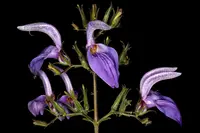
Its tubular violet to bluish flowers have an asymmetric, funnel-shaped corolla adapted to large bee pollinators, which enter the flower to reach nectar and in doing so contact the reproductive structures to transfer pollen.

FAQs about Brillantaisia cicatricosa

The flowers are rich in nectar and typically attract bees, butterflies, and sometimes hummingbirds in warm regions. Providing several plants together and avoiding broad-spectrum insecticides helps support more consistent pollinator visits throughout the flowering season.

Grow Healthy Plants with Botan Care

Keep your plants happy and healthy with plant identification, disease detection, and easy care guidance.

Botan plant care app — identify plants on mobile

Explore More Plants