Rock-crevice planting
Plant in narrow rock crevices or between stable stones to mimic its natural alpine habitat, which helps keep roots cool and reduces competition from more vigorous groundcovers.

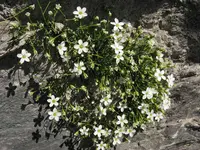
Moehringia lebrunii is a small, delicate perennial from rocky habitats, likely in cooler temperate regions. It typically forms low, cushion-like mats with fine stems and small, narrow leaves. Flowers are usually tiny, star-shaped, and pale, giving the plant a subtle but attractive look suited to rock gardens, troughs, or crevices. Its compact growth habit makes it suitable for detailed planting schemes rather than bold landscape use.
This species often prefers well-drained, mineral-rich substrates and steady moisture without waterlogging. In cultivation, it tends to be moderately demanding, mainly because it dislikes heat, heavy soils, and drought. Gardeners who care for Moehringia lebrunii need to pay attention to drainage and avoid extreme conditions.

Care Difficulty
Moderate Care

Light Preference
Partial Shade

Water Requirements
Moderate Water

Temperature Preference
Cool Climate

Hardiness Zone
Unknown

Soil Texture
Loamy, Rocky, Organic-rich

Soil pH
Slightly acidic (6.5–7.0)

Soil Drainage
Well-drained

Fertilization
Minimal (feed rarely)
Scan your plant to receive care tips personalized for your specific plant
Available on iOS and Android
This alpine perennial favors cool, bright conditions with protection from harsh midday sun.
This plant prefers consistently lightly moist soil but is sensitive to waterlogging.
This species prefers cool to mild conditions and dislikes extreme heat or severe frost.
This species is adapted to outdoor conditions and humidity is rarely a limiting factor.
Moehringia lebrunii prefers light, mineral-rich soil that drains quickly yet does not dry out instantly.
This species can be grown successfully in containers if drainage and root zone conditions are carefully managed.
This species is adapted to lean, rocky soils and usually needs no routine feeding in gardens.
Moehringia lebrunii needs only light, occasional pruning to keep cushions dense and tidy.
This plant is more often transplanted in rock gardens than grown long term in containers.
Gardeners usually propagate this species in small numbers, using either seed or division.
In suitable climates this alpine-type plant is fairly cold hardy and needs only modest winter care.

Plant Health Check
Not sure what's wrong with your plant? Check your plant's health inside the app.
Moehringia lebrunii is known from high-elevation habitats in the Albertine Rift region of central Africa, occurring in very localized, fragmented populations on rocky slopes and outcrops.
This species typically grows in cool, montane conditions on shallow, mineral-rich soils over rock, which makes it highly sensitive to changes in microclimate and land use.
Moehringia lebrunii is considered a range-restricted species with few known sites, so botanists monitor its habitats closely in the context of broader conservation work in central African montane ecosystems, which is important background for Moehringia lebrunii care instructions in cultivation trials.
This species is typically evergreen in mild climates, holding its fine foliage year-round. In colder regions, some foliage may thin or burn in winter, but the root system usually survives and sends out fresh growth in spring.
Keep your plants happy and healthy with plant identification, disease detection, and easy care guidance.