Bleeding glory-bower Care (Clerodendrum thomsoniae)

Also known as: Bleeding Heart Vine / Bleeding Hearts
Bleeding glory-bower

About Bleeding glory-bower

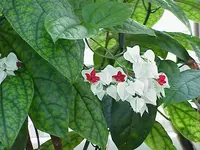
Bleeding glory-bower (Clerodendrum thomsoniae) is a woody tropical vine grown for its showy clusters of white, lantern-like bracts and bright red flowers. It is often trained on a trellis, arch, or support, and can be grown as a cascading container plant indoors in bright spaces.

This species comes from West Africa, where it grows in warm, humid forest edges and thickets. It can bloom for long periods when conditions are stable.

Gardeners who want to care for Bleeding glory-bower should know it prefers bright, indirect light, evenly moist but well-drained soil, and consistent warmth, so it is considered moderately easy with attention to its needs.

Main Plant Requirements

Care Difficulty

Moderate Care

Light Preference

Partial Sun

Water Requirements

Regular Water

Temperature Preference

Tropical / Frost Sensitive

Hardiness Zone

10–11

Soil Texture

Loamy, Sandy, Organic-rich

Soil pH

Acidic (5.5–6.5), Slightly acidic (6.5–7.0)

Soil Drainage

Moist but well-drained

Fertilization

Moderate (every 2–4 weeks)

Get Personalized Care Plan

Scan your plant to receive care tips personalized for your specific plant

Available on iOS and Android

How to Care for the Bleeding glory-bower

Clerodendrum thomsoniae performs best in bright, indirect light with some gentle direct sun.

  • Provide 4–6 hours of morning sun or filtered light daily; avoid strong midday sun that can scorch leaves and fade Bleeding glory-bower flowers.
  • Outdoors, place in light dappled shade under taller plants; indoors, set near an east- or bright north-facing window with sheer curtains.
  • In winter, move closer to the brightest window or supplement with grow lights if stems stretch and leaves lose color, indicating low light.

Clerodendrum thomsoniae prefers evenly moist, well-drained soil that never stays soggy.

  • Water when the top 2–4 cm of soil feel dry, using enough water to moisten the whole root zone, then let excess drain away completely.
  • Reduce watering in cooler months when growth slows, allowing the soil to dry slightly deeper while still preventing total dryness or leaf wilt.
  • Watch for yellowing, soft leaves or a sour smell as signs of overwatering, and crisp leaf edges or drooping, dry stems as signs of underwatering.

This species grows best in warm, stable conditions without cold drafts or sudden temperature swings.

  • Aim for 65–80°F (18–27°C) during active growth, which supports flowering and healthy foliage development.
  • Protect from temperatures below 50°F (10°C), as light frost can damage stems and leaves and prolonged cold may kill the plant.
  • In hot periods above 86°F (30°C), provide extra shade, good airflow, and closer monitoring of soil moisture to prevent heat stress.

This species benefits from moderately high, consistent humidity for best leaf health and flowering.

  • Aim for 50–60% humidity; it tolerates short dips lower but prolonged air below 40% often leads to leaf edge browning.
  • Dry indoor air causes curling leaves, crispy tips, and stalled buds in Bleeding glory-bower.
  • Increase humidity with a pebble tray under the pot or grouping plants, but avoid misting foliage heavily to reduce fungal risk.

Clerodendrum thomsoniae prefers an airy, moisture-retentive yet sharply draining substrate.

  • Use a loose, loamy mix of roughly 50% peat or coco coir, 30% compost, and 20% perlite or bark for structure and drainage.
  • Keep pH slightly acidic to neutral, around 6.0–7.0, to support nutrient availability and root function.
  • Improve aeration by adding extra perlite or fine bark if the mix feels heavy or compacts after watering.
  • Avoid dense garden soil, unamended clay, or constantly soggy mixes that promote root rot and poor growth.

This vine is well suited to container growing when the pot supports its vigorous, climbing habit.

  • Choose a relatively deep, heavy pot to counterbalance climbing growth and prevent tipping once the plant is trained on a support.
  • Select containers with large, unobstructed drainage holes so water exits quickly and the lower root zone does not stay saturated.
  • Use a slightly wider pot than the current root spread to allow lateral root expansion without creating a large volume of unused, wet mix.

Clerodendrum thomsoniae benefits from consistent feeding during its active growing season for strong growth and flowering.

  • Use a balanced liquid fertilizer (e.g., 10-10-10 or 20-20-20) diluted to 1/2 strength every 2–4 weeks in spring and summer.
  • Alternatively, top-dress with a thin layer of compost or use a slow-release fertilizer at the start of the growing season.
  • Suspend or greatly reduce feeding in fall and winter when growth slows, especially for Bleeding glory-bower kept indoors.
  • Always water before applying liquid fertilizer to reduce the risk of root burn and salt buildup.

Clerodendrum thomsoniae responds well to thoughtful pruning that maintains shape and encourages blooming wood.

  • Carry out main pruning in late winter or very early spring before strong new growth begins.
  • Remove dead, damaged, or crossing stems first, then thin crowded interior shoots to improve light and air flow.
  • Shorten long, leggy stems by 1/3–1/2 to keep a compact form and stimulate new flowering shoots.
  • Use clean, sharp hand pruners, making angled cuts just above healthy outward-facing buds.

This plant grows vigorously in containers and benefits from periodic repotting to refresh soil and support root health.

  • Check for roots circling the pot, emerging from drainage holes, or slowed top growth as signs it needs a larger container.
  • Plan to repot every 2–3 years in late winter or early spring, just before the main flush of new growth.
  • Move to a pot 1–2 in wider with fresh, well-draining mix, keeping the root ball at the same planting depth.
  • Gently loosen circling roots, water thoroughly after repotting, and keep in bright, indirect light for 1–2 weeks to limit stress.

Clerodendrum thomsoniae is most commonly propagated from softwood or semi-ripe stem cuttings taken during the warm season.

  • Take 8–12 cm cuttings in late spring or summer from non-flowering shoots, removing lower leaves.
  • Dip the cut end in rooting hormone to improve root formation and reduce rot risk.
  • Insert cuttings into a moist, well-draining medium such as perlite and peat or a fine seed-starting mix.
  • Provide bottom warmth around 70–75°F, bright indirect light, and high humidity until roots form in several weeks.

This tropical species is frost sensitive and needs protective winter care in most temperate climates.

  • In USDA zones colder than 10, grow Clerodendrum thomsoniae in containers and move indoors before temperatures drop below 50°F.
  • Overwinter indoors in bright, indirect light with temperatures around 60–70°F and reduced watering.
  • In mild climates, mulch the root zone with 5–8 cm of organic material to moderate soil temperature.

Care Tips

Provide climbing support

Install a narrow trellis or taut wires and gently tie young stems with soft ties so the vine can climb, which increases flowering surface and keeps growth controlled and easier to inspect for pests.

Strategic flower deadheading

After the red corollas fall, leave the white calyces on the plant until they fade, then snip the whole cluster back to the next pair of leaves to encourage new flowering shoots rather than seed production.

Light rotation for symmetry

Rotate the pot 90° every 1–2 weeks during active growth so all sides of the plant receive similar light, preventing a lopsided vine and helping you spot issues early while caring for Bleeding glory-bower.

Seasonal growth reset

At the end of winter, cut back long, thin, or leafless stems by about one-third and remove crossing branches to stimulate sturdy new growth that will carry more flowers in the coming season.

Prevent pest buildup

Once a month, rinse the foliage and stems with a gentle lukewarm shower and then inspect leaf undersides, shoot tips, and flower clusters closely, since early detection of spider mites and whiteflies is critical for keeping this species healthy.

Common Pests and Diseases

Spider mites

This pest often appears on plants kept in warm, dry indoor air and causes stippled, pale leaves and fine webbing on Clerodendrum thomsoniae. Symptoms include slowed growth and leaf drop if populations are high.

Solution

Rinse foliage thoroughly with a strong but gentle stream of lukewarm water, including the undersides of leaves, then repeat every few days for 1–2 weeks; increase humidity around the plant and avoid letting it dry out excessively. For persistent infestations, use insecticidal soap or a neem oil spray, applied carefully to all leaf surfaces according to label directions.

Whiteflies

These insects congregate on the undersides of leaves, flying up in a cloud when the plant is disturbed and causing yellowing, sticky leaves. Honeydew residue can lead to sooty mold on the showy bracts and foliage.

Solution

Remove heavily infested leaves, then use yellow sticky traps placed near the plant to capture adults. Regularly spray leaf undersides with insecticidal soap or neem oil, ensuring good coverage and repeating weekly until no new adults appear.

Mealybugs

This pest appears as white, cottony clusters in leaf axils, on stems, and around flower clusters, weakening the plant and distorting new growth. Symptoms include sticky honeydew and poor flowering.

Solution

Isolate the plant, then dab visible insects with cotton swabs dipped in isopropyl alcohol and wipe them off. Follow with repeated treatments of insecticidal soap or neem oil every 7–10 days, and prune out badly infested shoots to reduce reinfestation.

Leaf spot

This disease causes dark, irregular spots on leaves that may have yellow halos and can lead to premature leaf drop, especially in dense, poorly ventilated foliage of Bleeding glory-bower. Symptoms include more rapid spread during warm, humid conditions or overhead watering.

Solution

Remove and discard affected leaves, then improve air circulation by thinning dense growth and avoiding water on the foliage. If spotting continues to spread, apply a copper-based or other labeled ornamental fungicide, following product instructions and spacing waterings so the surface of the potting mix dries slightly between each.

Powdery mildew

This disease produces a white, powdery coating on leaves and young stems, which can cause curling, distortion, and reduced flowering. Symptoms include most severe infection in shaded, crowded conditions with poor air movement.

Solution

Increase light within the recommended range, improve airflow, and avoid overcrowding plants; remove the worst-affected leaves to reduce spore load. If needed, use a labeled fungicide for powdery mildew or a horticultural oil spray, applied in the evening or under low light to avoid leaf burn and repeated according to label guidance.

Interesting Facts

Color-changing flower display

The flowers open with white, balloon-like calyces that gradually age to pink or deep red while the red corolla often drops, creating a two-tone effect on the same cluster. This sequential color change helps attract pollinators at different flowering stages.

Native West African liana

This species is a woody liana native to humid forests of West Africa, where it grows as a scrambling climber through shrubs and small trees rather than as a free-standing shrub. In cultivation it is often trained on trellises or supports to mimic this growth habit.

Triggered by bright seasons

In suitable climates the plant tends to flower most heavily in response to increasing light and warmth after a relatively drier or cooler period. Under controlled conditions, growers sometimes use a short rest phase followed by stronger light to synchronize flowering clusters.

Botan icon

Did you know?

The species name thomsoniae honors the Scottish missionary and naturalist Thomas Thomson, reflecting a 19th-century tradition of European botanists naming tropical ornamentals after explorers and collectors who helped introduce them to horticulture.

FAQs about Bleeding glory-bower

Lack of blooms often comes from insufficient light, old non-flowering wood, or nutrient imbalance. Provide strong bright light, avoid heavy high-nitrogen fertilizers, and prune lightly after flowering so new growth can set buds the following season.

Grow Healthy Plants with Botan Care

Keep your plants happy and healthy with plant identification, disease detection, and easy care guidance.

Botan plant care app — identify plants on mobile

Explore More Plants