Summer dormancy management
Allow foliage to yellow and die back naturally in late summer, then mark clump locations with discreet labels so you do not accidentally dig into the crowns when the plant is dormant and invisible.

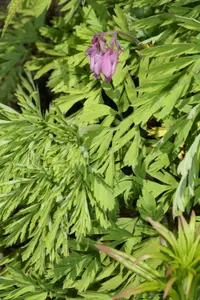
Pacific bleeding heart, Dicentra formosa, is a compact woodland perennial known for its soft mounds of fern-like foliage and dangling, heart-shaped flowers. It typically forms low, spreading clumps that create a natural, layered look in shaded beds and under trees.
This species is native to the Pacific Northwest of North America, where it grows in cool, moist forest habitats. It is considered relatively easy to grow if its basic needs are met, but it dislikes heat, drought, and poorly drained soil.
Gardeners who learn how to care for Pacific bleeding heart usually focus on providing light shade, consistent moisture, and rich, humus-based soil to mimic its natural woodland conditions.

Care Difficulty
Moderate Care

Light Preference
Partial Shade

Water Requirements
Regular Water

Temperature Preference
Cold Hardy

Hardiness Zone
3–9

Soil Texture
Loamy, Silty, Organic-rich

Soil pH
Acidic (5.5–6.5), Slightly acidic (6.5–7.0)

Soil Drainage
Moist but well-drained

Fertilization
Minimal (feed rarely)
Scan your plant to receive care tips personalized for your specific plant
Available on iOS and Android
Dicentra formosa grows best in bright shade that mimics a cool woodland edge.
This woodland perennial prefers evenly moist, cool soil rather than alternating drought and saturation.
This species is adapted to cool, mild conditions with marked seasonal change.
Dicentra formosa prefers moderately moist air but usually copes with typical indoor humidity levels.
Dicentra formosa grows best in loose, humus-rich soil that stays evenly moist but never waterlogged.
This species can grow in containers if the pot is set up to mimic cool, evenly moist woodland soil.
Pacific bleeding heart needs only light feeding in average garden soil.
Pruning Dicentra formosa focuses on tidiness and encouraging fresh foliage.
This species is usually grown in the ground and dislikes frequent disturbance.
Dicentra formosa is commonly propagated by division or seed in garden settings.
This woodland perennial is generally cold hardy and needs minimal winter care in most temperate climates.

Plant Health Check
Not sure what's wrong with your plant? Check your plant's health inside the app.
This species is naturally distributed along the Pacific coast from British Columbia to California, where it grows in cool, moist forests, rocky slopes, and coastal bluffs, often forming loose colonies in partial shade.
Dicentra formosa often goes partially or fully dormant in mid to late summer, with foliage dying back to underground rhizomes that allow it to survive seasonal dryness and resprout when cooler, wetter conditions return.
The nodding, heart-shaped flowers are adapted for pollination mainly by long-tongued bees, which can reach the nectar hidden in the tubular portion of the corolla while transferring pollen between plants.

In parts of its native range, Dicentra formosa hybridizes naturally with the closely related Dicentra spectabilis (Lamprocapnos spectabilis), producing intermediate forms that show a blend of flower shape, size, and color from both parent species.
Lack of blooms usually comes from plants being too young, stressed by heat or drought, or recently divided. Deep shade, heavy feeding, or root disturbance also reduce flowering. Provide stable moisture and allow clumps a season to re-establish.
Keep your plants happy and healthy with plant identification, disease detection, and easy care guidance.