Seasonal rest handling
After flowering, gradually reduce watering and fertilizer as new pseudobulbs mature, allowing a cooler, slightly drier rest so buds set properly for the next season.

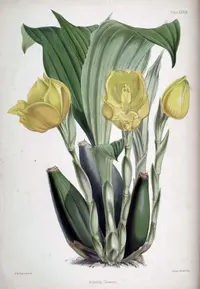
Anguloa clowesii is a terrestrial orchid known for its large, tulip-shaped flowers and robust, pleated leaves. It forms tight clumps from pseudobulbs, which store water and nutrients. This species comes from cool to mild, high-elevation forests in the Andes of South America, where it grows in leaf litter and humus-rich soil. Its flowers are typically yellow, waxy, and fragrant, appearing on short stalks close to the base of the plant. It is considered moderately challenging, as it dislikes temperature extremes and needs stable moisture with good aeration around the roots. Understanding how to care for Anguloa clowesii starts with providing bright, filtered light and evenly moist, well-drained substrate.

Care Difficulty
Hard Care

Light Preference
Partial Shade

Water Requirements
Keep Soil Moist

Temperature Preference
Tropical / Frost Sensitive

Hardiness Zone
Unknown

Soil Texture
Peaty, Organic-rich

Soil pH
Acidic (5.5–6.5)

Soil Drainage
Moist but well-drained

Fertilization
Moderate (every 2–4 weeks)
Scan your plant to receive care tips personalized for your specific plant
Available on iOS and Android
This orchid prefers bright, gentle light similar to high, filtered forest shade.
Watering should keep the root zone moist but never saturated, with a short dry pause between waterings.
This species prefers intermediate to cool-intermediate conditions with a distinct, gentle temperature drop at night.
This orchid needs consistently high humidity to grow well.
This terrestrial orchid needs a loose, airy, fast-draining mix rather than dense potting soil.
This species is well suited to container growing when the pot supports its fleshy roots and tall growth.
Nutrient management supports strong growth and reliable flowering in Anguloa clowesii.
Pruning needs are minimal and focus on hygiene and maintaining healthy growth.
Repotting maintains healthy roots and stable growth in this sympodial orchid.
Propagation is usually done by division rather than from seed, which is highly technical.
Cool, dry rest in winter is important for flowering, but the plant is not frost tolerant.

Plant Health Check
Not sure what's wrong with your plant? Check your plant's health inside the app.
The flower buds are large, waxy, and tulip-shaped, remaining tightly closed for an extended period before opening into a cup of thick, yellow petals. This distinctive bud form is what gives the genus its common name tulip orchid.
The flowers often release a stronger, sweet fragrance during warmer parts of the day, which is thought to help attract specific insect pollinators in its native Andean habitats.
This species is naturally found in cool, misty montane forests of Colombia and nearby regions at moderate to high elevations, where it grows in deep, humus-rich leaf litter under bright but filtered light.

In its native range, this orchid typically grows on the forest floor rather than in tree canopies, making it unusual among many popular orchid species that are predominantly epiphytic and live attached to bark high above the ground.
Lack of flowering usually comes from insufficient cool nights, inadequate light, or too few developed pseudobulbs. This species needs a slight temperature drop, steady nutrition, and a defined rest phase after growth to set strong flower buds.
Keep your plants happy and healthy with plant identification, disease detection, and easy care guidance.