kidneyleaf grass of Parnassus Care (Parnassia asarifolia)

Also known as: Grass-of-Parnassus, kidney-leaved grass-of-Parnassus

About kidneyleaf grass of Parnassus

Kidneyleaf grass of Parnassus (Parnassia asarifolia) is a small, herbaceous perennial native to wet mountain habitats in the southeastern United States. It typically grows in seeps, bog edges, and along cool stream banks.

The plant forms low rosettes of rounded, kidney-shaped basal leaves and sends up slender flowering stems topped with delicate white, veined blooms. It has a clumping habit and stays compact, which suits small garden spaces and naturalistic plantings.

This species prefers consistently moist, cool soils and does best in partial shade and humus-rich, slightly acidic ground. Gardeners who can match these conditions will generally find it moderate in difficulty to grow and easier to care for kidneyleaf grass of Parnassus than many other bog specialists.

Main Plant Requirements

Care Difficulty

Moderate Care

Light Preference

Partial Shade

Water Requirements

Keep Soil Moist

Temperature Preference

Cool Climate

Hardiness Zone

5–8

Soil Texture

Loamy, Silty, Organic-rich

Soil pH

Acidic (5.5–6.5), Slightly acidic (6.5–7.0)

Soil Drainage

Waterlogged tolerant

Fertilization

Minimal (feed rarely)

Get Personalized Care Plan

Scan your plant to receive care tips personalized for your specific plant

Available on iOS and Android

How to Care for the kidneyleaf grass of Parnassus

This species prefers bright, cool conditions that mimic open, boggy stream edges.

  • Provide 3–5 hours of soft morning sun with light shade or dappled light during stronger afternoon rays.
  • Allow partial shade, especially in hotter climates, to prevent leaf scorch; avoid full, exposed midday sun in summer.
  • In summer, protect kidneyleaf grass of Parnassus with filtered light or light woodland shade, while in spring and fall it can tolerate slightly more direct sun.

This plant naturally grows in consistently moist to wet soils and dislikes drying out.

  • Keep soil evenly moist, never letting the top 1–2 cm dry completely; in boggy or streamside sites, shallow standing water is acceptable.
  • In cooler months, maintain moisture but reduce added water slightly if growth slows and evaporation decreases.
  • Watch for yellowing, limp foliage and sour smell as signs of waterlogging, and for drooping, dull leaves and shrinking foliage as signs of underwatering in Parnassia asarifolia.

This plant is a cool-temperate species adapted to moist, sheltered habitats.

  • Optimal growth occurs around 55–70°F (13–21°C), with steady moisture and protection from drying winds.
  • It tolerates winter cold down to about 0°F (-18°C) when established and mulched, dying back above ground and resprouting in spring.
  • Heat above 80–85°F (27–29°C) can stress plants; increase shade and soil moisture during hot spells to reduce stress and leaf scorch.

This wetland perennial needs consistently moist air but adapts to typical outdoor humidity in most temperate regions.

  • Aim for 50–80% humidity, which is naturally available near ponds, streams, or boggy beds.
  • Leaves that brown at the edges or curl while soil stays wet suggest air is too dry or wind exposure is high.
  • To increase humidity, group plants near other moisture-loving species or place containers in sheltered, splash-prone spots by water features.

This species thrives in saturated, organic-rich soils that mimic bog or seep habitats.

  • Use a fine-textured, peat- or coir-based mix with plenty of leaf mold or compost to maintain constant moisture and organic matter.
  • Ensure slow drainage rather than free-draining soil; a mix of 2 parts peat or coir to 1 part compost and 1 part sand works well.
  • Keep pH slightly acidic to neutral (pH 5.5–7.0), avoiding alkaline, chalky substrates that can limit nutrient availability.
  • Avoid compacted clay, very sandy, or fast-draining potting mixes, and never allow Parnassia asarifolia roots to dry out completely.

This plant can be grown in containers if the pot is managed like a mini bog rather than a standard free-draining planter.

  • Choose a deep, non-porous plastic pot or glazed container that slows evaporation and allows a permanent water reservoir in the lower third.
  • Stand the pot in a shallow tray of water so the lower drainage holes remain just at or slightly above the waterline, preventing full waterlogging of the crown.
  • Stabilize the container in a heavy outer cachepot or sink it partly into the ground near a water feature to keep roots cool and reduce tipping in wind while growing kidneyleaf grass of Parnassus.

This wetland perennial grows in lean soils and needs only light feeding to stay healthy.

  • For kidneyleaf grass of Parnassus in garden beds, apply a thin layer of compost in early spring as new growth starts.
  • In containers, use a diluted balanced liquid fertilizer (around 10-10-10) at 1/4–1/2 strength every 4–6 weeks during active growth.
  • Avoid high-nitrogen products, which can cause weak, lush foliage instead of sturdy flowering stems.
  • Stop feeding in late fall and during winter dormancy to prevent soft, frost-prone growth.

Parnassia asarifolia needs only light pruning to stay tidy and flower well.

  • In late fall or early spring, remove spent flower stalks at the base to keep plants neat and encourage fresh growth.
  • Snip off dead, damaged, or diseased leaves with clean, sharp scissors or hand pruners to limit fungal problems.
  • Thin out crowded rosettes lightly so air can move between plants, reducing rot in damp conditions.
  • Avoid heavy cutting into healthy foliage, as this small perennial relies on its leaves for energy storage.

This species is usually grown in the ground, so focus on careful transplanting rather than frequent repotting.

  • Transplant in early spring or early fall when temperatures are mild and soil is evenly moist.
  • Move clumps only when growth slows, flowering declines, or plants are shaded out by neighbors.
  • Lift with a wide soil ball, keep roots constantly moist, and replant at the same depth in a similar, consistently damp site.
  • Water thoroughly after transplanting and shade lightly for 3–5 days to reduce transplant shock.

Parnassia asarifolia is most often propagated by seed or gentle division in cool, moist conditions.

  • Sow fresh seed in fall outdoors; natural winter chilling improves germination in spring.
  • Use a fine, moist, low-nutrient mix and keep the tray consistently damp but not flooded.
  • For division, lift small clumps in early spring, tease apart rooted offsets, and replant immediately in wet, humus-rich soil.
  • Keep new divisions shaded from strong sun and evenly moist until strong new leaves form.

This perennial is generally cold hardy in suitable climates and needs only modest winter care outdoors.

  • Tolerates typical freezes in much of its native range when soil stays moist and does not dry out completely.
  • Apply a light 3–5 cm mulch of leaf mold or fine bark after the ground cools to buffer root temperature swings.
  • Container plants in colder regions can be sunk into the ground or moved to a cold, frost-free, bright shelter.

Care Tips

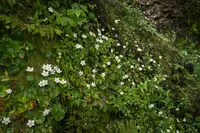
Streamside microhabitat

If planting near a garden pond or artificial stream, place plants slightly above the waterline in a shallow swale filled with humus-rich sand so the crown stays moist but not submerged.

Summer cooling mulch

Apply a thin, light-colored mineral mulch such as fine gravel over the root zone in early summer to keep the shallow roots cool and reduce moisture fluctuations without smothering the crown.

Gentle competition control

Hand-weed regularly and use small trimming shears rather than hoes or cultivators around the plant, since its fine surface roots are easily damaged by deeper soil disturbance.

Moisture mapping

In larger beds, place simple soil moisture gauges or marked bamboo skewers at different distances from the plant to learn how quickly each spot dries, then adjust irrigation emitters or drip lines so the plant’s root zone never fully dries.

Targeted slug management

In damp sites, protect flower stalks by setting low, covered slug traps or using iron phosphate pellets along the outer edge of the bed instead of right at the crown, reducing damage without disturbing natural pollinators when growing kidneyleaf grass of Parnassus.

Common Pests and Diseases

Leaf spot fungi

This disease causes small water-soaked or tan spots on leaves that may merge into larger irregular patches, especially in warm, wet conditions. Symptoms include yellowing and early drop of older foliage in dense clumps.

Solution

Remove and dispose of affected leaves, avoid overhead watering, and space plants to improve air movement. In persistent cases in garden beds, apply a copper-based fungicide labeled for ornamental perennials at the first sign of spotting, following label directions and keeping spray off nearby streams or wetlands.

Powdery mildew

This disease appears as a white or gray powdery coating on upper leaf surfaces and sometimes on flower stalks, more often in stagnant, humid air with some shade. Symptoms include distorted growth and reduced flowering when infections are heavy.

Solution

Increase air circulation by thinning crowded plants and removing nearby dense vegetation, and water at soil level so foliage stays dry. If needed, treat early with a sulfur or potassium bicarbonate product labeled for ornamentals, and avoid high-nitrogen fertilization that encourages soft, mildew-prone growth.

Aphids

These insects cluster on tender stems, undersides of leaves, and flower stalks, sucking sap and excreting sticky honeydew that can attract sooty mold. Symptoms include curled or twisted new growth and reduced vigor in dense infestations.

Solution

Dislodge colonies by spraying plants with a firm stream of water, and pinch off heavily infested shoot tips. For ongoing problems, use insecticidal soap or a light horticultural oil, coating the undersides of leaves and repeating as needed while protecting nearby beneficial insects.

Leaf-mining larvae

This pest lives inside the leaf tissue and creates winding, pale tunnels or blotches that can make foliage look scorched or translucent. Symptoms include cosmetic damage and, in severe cases, reduced photosynthesis and vigor in small clumps.

Solution

Hand-remove and destroy mined leaves as soon as damage is noticed to interrupt the life cycle. For recurrent issues in the same planting, encourage natural predators and avoid broad-spectrum insecticides, or use a targeted systemic product only if damage is extensive and other methods fail.

Interesting Facts

Specialized false nectaries

The small, fringed structures that look like extra petals are sterile stamens that bear glistening, drop‑like glands, which mimic nectar to attract pollinating insects even though they produce no true nectar.

Mountain seep specialist

This species is strongly tied to cold, constantly saturated habitats such as Appalachian seeps and stream margins, where its shallow roots anchor in mossy, low‑nutrient substrates fed by clean, slow‑moving groundwater.

Restricted southeastern range

The plant is native to the southeastern United States, mainly in the southern Appalachian region, and its patchy distribution reflects the scattered occurrence of suitable cool, wet microhabitats rather than broad climatic limits.

Botan icon

Did you know?

The intricate floral patterning of this species, including translucent veins on the true petals and bright, bead‑like glands on the sterile stamens, creates strong visual contrast in the ultraviolet range that pollinating insects can see, helping guide them precisely to the reproductive structures of the flower.

FAQs about kidneyleaf grass of Parnassus

This species is a herbaceous perennial. The foliage dies back after the growing season, but underground structures survive and resprout each year when conditions are cool and moist, forming small clumps that slowly increase over time.

Grow Healthy Plants with Botan Care

Keep your plants happy and healthy with plant identification, disease detection, and easy care guidance.

Botan plant care app — identify plants on mobile

Explore More Plants