Mounting strategy
Use a rough-barked hardwood slab or cork mount with a thin pad of long-fiber sphagnum only around the roots, leaving rhizomes exposed so new growths can spread and dry quickly between waterings.

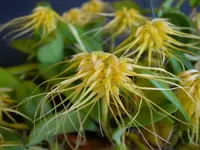
Bulbophyllum vaginatum is a small to medium epiphytic orchid that grows attached to tree branches rather than in soil. It forms compact clumps of pseudobulbs with narrow leaves and produces unusual, often dangling flower clusters.
This species is native to humid tropical forests of Southeast Asia, where it experiences warm, stable temperatures and good air movement. Its growth habit and need for high humidity make it more suitable for growers with some orchid experience.
To care for Bulbophyllum vaginatum, growers typically provide bright shade, constant moisture around the roots, and a very airy mounting or fine bark substrate to prevent stagnation and root rot.

Care Difficulty
Hard Care

Light Preference
Partial Shade

Water Requirements
Keep Soil Moist

Temperature Preference
Tropical / Frost Sensitive

Hardiness Zone
12–13

Soil Texture
Peaty, Organic-rich

Soil pH
Acidic (5.5–6.5)

Soil Drainage
Moist but well-drained

Fertilization
Moderate (every 2–4 weeks)
Scan your plant to receive care tips personalized for your specific plant
Available on iOS and Android
This orchid prefers bright, filtered light that mimics dappled forest conditions.
Watering should keep roots moist but never stagnant around this epiphytic orchid.
This species prefers consistently warm, frost-free conditions with only slight seasonal variation.
This orchid needs high, stable humidity to stay healthy and flower reliably.
This epiphytic orchid prefers a very open, airy medium rather than compact mineral soil.
This species is well suited to container growing, especially in baskets or shallow orchid pots.
This epiphytic orchid benefits from light, consistent feeding during active growth for balanced Bulbophyllum vaginatum plant care.
Bulbophyllum vaginatum needs minimal pruning focused on hygiene rather than reshaping.
This species prefers stable conditions, so repot Bulbophyllum vaginatum only when clearly necessary.
Bulbophyllum vaginatum is usually propagated by careful division of mature clumps rather than from seed.
Bulbophyllum vaginatum is a warmth-loving orchid that must be kept above freezing in winter.

Plant Health Check
Not sure what's wrong with your plant? Check your plant's health inside the app.
This species produces short-lived, often foul-scented flowers that are adapted to attract small flies, which act as the primary pollinators on its native Southeast Asian forest hosts.
It naturally grows as an epiphyte on tree trunks and branches in warm, humid lowland forests, anchoring to bark with its roots while taking moisture and nutrients from rain, leaf litter, and the surrounding air.
The plant forms tight clusters of small pseudobulbs connected by creeping rhizomes, allowing it to spread over bark surfaces and rapidly occupy small, mossy niches on its host tree.

In some parts of its native range, this species is one of the more frequently encountered Bulbophyllum orchids on older rainforest trees, forming conspicuous mats that can host small invertebrates within the moss and leaf debris trapped around its roots.
This species usually flowers in warm seasons, often from late spring through early fall, depending on climate. Under stable conditions it can bloom several times a year, producing short-lived but repeat flushes of flowers.
Keep your plants happy and healthy with plant identification, disease detection, and easy care guidance.