Choose host wood
Inoculate only freshly cut or recently fallen, undecayed hardwood logs to reduce competition from other fungi and improve establishment success.

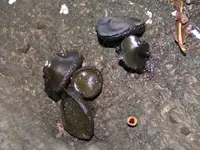
Poor man's licorice, Bulgaria inquinans, is not a leafy plant but a wood-rotting fungus that forms small, dark, cup-shaped cushions on dead hardwood. The surface often looks smooth and shiny, while the edges stay slightly raised and irregular.
It occurs mainly in temperate forests, especially on fallen oak branches and logs in Europe and parts of North America. It spreads by spores and tends to appear in scattered groups rather than single large clusters.
Because it depends on decaying wood and stable moisture, it is not a typical garden or houseplant species, and deliberate cultivation is uncommon. Anyone wanting to learn how to care for Poor Man's Licorice should understand that success largely depends on providing cool, damp conditions and access to suitable dead wood.

Care Difficulty
Moderate Care

Light Preference
Partial Shade

Water Requirements
Keep Soil Moist

Temperature Preference
Cool Climate

Hardiness Zone
Unknown

Soil Texture
Loamy, Organic-rich

Soil pH
Acidic (5.5–6.5)

Soil Drainage
Moist but well-drained

Fertilization
Minimal (feed rarely)
Scan your plant to receive care tips personalized for your specific plant
Available on iOS and Android
This fungus prefers cool, shaded woodland light rather than strong direct sun.
Moist, well-drained wood is more important than direct watering for this saprophytic fungus.
This species thrives in cool to mild conditions typical of temperate woodlands.
Humidity plays a minor role for Bulgaria inquinans, which is naturally tolerant of outdoor fluctuations.
Bulgaria inquinans develops best on moist, well-aerated, organic substrates rather than conventional garden soil.
This species is not naturally suited to conventional container growing, though it can be experimented with on hardwood-filled tubs or boxes.
This fungus grows on decaying hardwood and does not need added fertilizer in natural or garden settings, even when caring for Poor Man's Licorice.
Bulgaria inquinans requires no true pruning, but fruiting bodies and host wood can be tidied for appearance or safety.
This wood-inhabiting fungus is not suited to normal pot culture, so focus on relocating colonized wood rather than classic repotting.
Propagation of Bulgaria inquinans is usually left to natural spore spread, and deliberate methods are technically possible but rarely used in home settings.
This species is cold hardy across most temperate climates and generally needs no special winter care.

Plant Health Check
Not sure what's wrong with your plant? Check your plant's health inside the app.
This ascomycete fungus produces black, rubbery, disc-shaped fruiting bodies that resemble drops of tar on dead oak wood, with a gelatinous texture that becomes harder and more brittle when dry.
It is strongly associated with dead or fallen oak wood and is only rarely found on other hardwoods, so its presence can indicate long-term oak habitat continuity in a woodland.
The fertile surface is lined with asci, which are microscopic sac-like structures that forcibly discharge spores into the air, a typical but visually striking feature of members of the order Helotiales.

The dark pigments in its fruiting bodies are thought to shield reproductive tissues from ultraviolet radiation and desiccation, which helps the fungus persist on exposed, sunlit dead oak branches for extended periods.
This fungus spreads by releasing spores from its black, cup-like fruiting bodies, usually on decaying hardwood. It can appear in clusters but is not considered aggressively spreading or invasive in managed garden settings.
Keep your plants happy and healthy with plant identification, disease detection, and easy care guidance.