


Substrate selection
Grow Byssomerulius corium on untreated, well-seasoned hardwood pieces (e.g. oak, beech, maple) rather than fresh or resinous wood, as older lignin-rich wood gives the fungus a more stable, slowly decomposing food source.

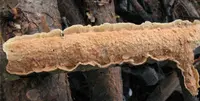
Netted crust, Byssomerulius corium, is a thin, crust-like wood-decay fungus rather than a typical leafy houseplant. It forms low, spreading patches with a pale, netted surface that sits flat against dead branches or logs. The fruiting layer often looks like a fine maze of ridges and pores.
This species occurs widely in temperate forests, especially on fallen hardwoods, where it helps break down lignin and other tough wood components. It is not commonly cultivated indoors, and attempts to care for Netted Crust at home are experimental and suited only to advanced growers.
In nature it favors shaded, consistently moist, well-ventilated habitats with abundant dead wood as its nutrient source.

Care Difficulty
Moderate Care

Light Preference
Shade

Water Requirements
Keep Soil Moist

Temperature Preference
Cool Climate

Hardiness Zone
Unknown

Soil Texture
Loamy, Organic-rich

Soil pH
Acidic (5.5–6.5)

Soil Drainage
Moist but well-drained

Fertilization
Minimal (feed rarely)
Scan your plant to receive care tips personalized for your specific plant
Available on iOS and Android
This wood-decaying crust fungus thrives on shaded, dead hardwood rather than direct sun exposure.
This lignicolous fungus depends on consistently moist but not waterlogged wood rather than direct watering.
This saprobic fungus is adapted to cool to mild forest conditions and can tolerate a fairly broad temperature range.
Humidity is not a significant factor for Byssomerulius corium on outdoor wood surfaces.
Byssomerulius corium naturally colonizes dead wood rather than soil, so focus on preparing a woody substrate.
This species is not suitable for conventional container growing, as it requires decaying wood rather than potting mix.
This crust fungus grows on dead wood and does not need supplemental fertilization in garden or indoor settings.
Pruning is generally unnecessary for Byssomerulius corium because it lives on dead woody substrates rather than as a traditional garden plant.
This species is not managed like a potted plant, so direct transplanting is rarely practical or necessary.
Propagation of this saprophytic fungus is specialized and usually limited to laboratory or experienced hobby culture.
Outdoor colonies on logs or branches are typically cold hardy and need no specific winter care in most temperate climates.

Plant Health Check
Not sure what's wrong with your plant? Check your plant's health inside the app.
This species forms extremely thin, resupinate fruiting bodies that lie flat and tightly attached to the underside of dead wood, creating a smooth to slightly wrinkled, skin-like layer rather than a typical cap and stem.
It is a white-rot fungus that breaks down both lignin and cellulose in dead hardwoods, playing a key role in nutrient recycling within temperate forest ecosystems.
This fungus has been recorded from multiple temperate regions across the Northern Hemisphere, where it is commonly found on the underside of fallen branches and logs in moist, shaded forest habitats.

Microscopically, this species is characterized by smooth, hyaline (transparent) spores and a distinctive hymenial surface with small, often barely visible pores or wrinkles, features that are essential for accurate identification by mycologists studying corticioid fungi.
This fungus is not considered edible. It forms thin, crust-like fruiting bodies on dead wood and lacks culinary value. Some related crust fungi may contain unknown or irritant compounds, so it is safest to avoid consumption entirely.
Keep your plants happy and healthy with plant identification, disease detection, and easy care guidance.

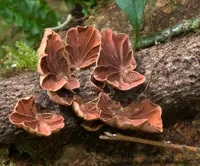
Orange Fan
Anthracophyllum archeri
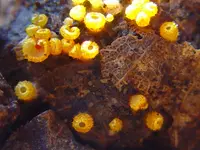
Arachnopeziza aurelia
Arachnopeziza aurelia
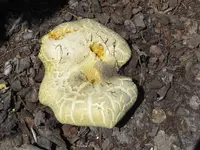
Golden Bolete
Buchwaldoboletus sphaerocephalus
Butyriboletus brunneus
Butyriboletus brunneus
Poor Man's Licorice
Bulgaria inquinans
couscous crust
Bulbillomyces farinosus
Acrospermum compressum
Acrospermum compressum
disc lichen
Buellia griseovirens