Secure Climbing Canes
Install strong, rust-resistant wires or a mesh panel and tie new canes loosely with soft horticultural ties so the spiny stems can climb safely without cutting into the tissue.

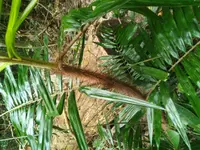
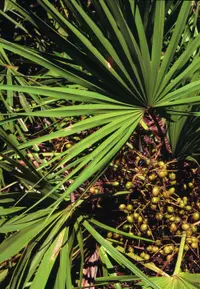
Wait-a-while, Calamus australis, is a climbing rattan palm native to tropical rainforests of northern Australia. It grows as a vigorous, scrambling vine with long, cane-like stems. The stems carry arching fronds with narrow leaflets and hooked spines that help the plant climb and also make handling difficult. Mature plants can form dense thickets in the wild. This growth habit makes the species impressive but challenging to manage in most home gardens. It prefers warm, humid conditions, consistent moisture, and rich, well-drained soil, so anyone planning to care for wait-a-while should be prepared to mimic its rainforest environment as closely as possible.

Care Difficulty
Hard Care

Light Preference
Partial Shade

Water Requirements
Keep Soil Moist

Temperature Preference
Tropical / Frost Sensitive

Hardiness Zone
11–12

Soil Texture
Sandy, Loamy, Organic-rich

Soil pH
Acidic (5.5–6.5), Slightly acidic (6.5–7.0)

Soil Drainage
Moist but well-drained

Fertilization
Minimal (feed rarely)
Scan your plant to receive care tips personalized for your specific plant
Available on iOS and Android
Calamus australis prefers bright, filtered light that mimics its native tropical forest understory.
This species prefers consistently moist but not waterlogged soil, similar to a humid rainforest floor.
This rattan palm thrives in warm, humid conditions and reacts poorly to cold or frost.
This climbing rattan prefers consistently humid air similar to tropical forest edges.
Calamus australis prefers moist, well-aerated, organic-rich soil that drains freely yet does not dry out quickly.
This species can be grown in large, sturdy containers when space and support structures are available.
Calamus australis, or wait-a-while, responds to modest feeding in cultivation, especially in poor or soilless mixes.
Pruning Calamus australis is mainly about safety and access management, not shaping like typical ornamental palms.
This climbing rattan palm is rarely kept long term in containers, so transplanting to a permanent site is more important than frequent repotting.
Calamus australis is usually propagated from seed, which requires patience and warm, stable conditions.
This tropical rattan palm is frost sensitive and needs thoughtful winter management outside its native warm range.

Plant Health Check
Not sure what's wrong with your plant? Check your plant's health inside the app.
This rattan palm uses long, whip-like flagella lined with backward-pointing hooks on the leaf rachis and leaf tips to climb over rainforest vegetation instead of developing a self-supporting trunk.
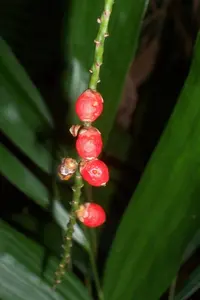
Its fleshy fruits are eaten and dispersed by the southern cassowary, making the plant part of an important seed dispersal network in tropical rainforests of northeastern Australia.
The stems, leaves, and climbing organs are covered in sharp spines that deter large herbivores and help the plant anchor itself as it scrambles toward higher light levels in the canopy.
Indigenous communities in northern Australia traditionally use the long, strong canes of this species for weaving and construction, taking advantage of their notable flexibility and durability once the outer spiny layer is removed.
This species is a climbing, clustering rattan palm. It uses hooked spines on stems and leaf sheaths to latch onto surrounding vegetation and pull itself upward, often forming dense, impenetrable tangles in suitable conditions.
Keep your plants happy and healthy with plant identification, disease detection, and easy care guidance.