Angraecum ramosum Care

Angraecum ramosum

About Angraecum ramosum

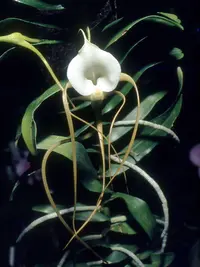
Angraecum ramosum is a small epiphytic orchid, usually found growing on trees in humid forests of Madagascar and nearby islands. It forms compact clumps with slender stems and narrow, leathery leaves. Its flowers are typically white to greenish, often star-shaped, and can be fragrant, especially in the evening. The plant has a moderate growth rate and stays relatively small, which makes it suitable for limited spaces. This species can be moderately challenging, as it prefers stable warmth, good air movement, and evenly moist roots without waterlogging. Understanding how to care for Angraecum ramosum helps reduce stress from sudden changes in light, humidity, or temperature.

Main Plant Requirements

Care Difficulty

Hard Care

Light Preference

Bright Indirect Light

Water Requirements

Keep Soil Moist

Temperature Preference

Tropical / Frost Sensitive

Hardiness Zone

Unknown

Soil Texture

Peaty, Organic-rich, Sandy

Soil pH

Acidic (5.5–6.5)

Soil Drainage

Well-drained

Fertilization

Moderate (every 2–4 weeks)

Get Personalized Care Plan

Scan your plant to receive care tips personalized for your specific plant

Available on iOS and Android

How to Care for the Angraecum ramosum

This orchid prefers bright but gentle light that mimics high forest canopy conditions.

  • Provide 10–12 hours of bright, filtered light daily, such as dappled shade under taller plants or 30–50% shade cloth outdoors.
  • Allow soft morning sun but protect from strong midday and afternoon sun, which can scorch leaves or cause yellow, leathery patches on Angraecum ramosum.
  • If stems elongate, leaves darken, or flowering declines, increase light slightly, especially in winter when day length shortens.

Watering should keep roots lightly moist but never stagnant or waterlogged.

  • Water when the surface roots and mounting material or top 2–3 cm of mix feel just barely dry, then soak thoroughly so excess drains away completely.
  • Reduce watering in cooler months, allowing a bit more drying, and increase frequency in warm, active growth when roots turn silvery between waterings.
  • Watch for shriveled leaves or roots as signs of underwatering, and for limp, yellowing leaves or a sour smell in the medium as signs of overwatering and poor drainage.

Stable, warm conditions support steady growth and flowering in this orchid.

  • Aim for 65–80°F (18–27°C) during the day and 60–70°F (16–21°C) at night to match typical Angraecum ramosum care instructions.
  • Protect the plant from temperatures below 50°F (10°C), since prolonged chills can damage roots and leaves even without visible frost.
  • In hot periods above 85°F (29°C), increase air movement and humidity, and shade slightly more to prevent heat stress and leaf scorch.

This orchid prefers consistently moist air and reacts quickly to dry conditions.

  • Aim for 60–80% humidity, as lower than 50% often leads to slower growth and duller leaves.
  • Dry indoor air causes wrinkled roots, limp leaves, and bud drop, especially near heating or cooling vents.
  • Increase humidity with a pebble tray under the pot, groupings of plants, or a fine mist in the morning, avoiding water sitting in the crown.

This species grows best in a very airy, fast-draining epiphytic mix rather than traditional potting soil.

  • Use a medium-grade orchid bark base with additions of chunky perlite and a little sphagnum moss to retain light moisture.
  • Aim for a loose, open structure that allows air to reach roots and lets water drain through in seconds, not minutes.
  • Keep pH slightly acidic to neutral (pH 5.5–7.0), which suits nutrient uptake in bark-based orchid substrates.
  • Avoid dense peat, regular houseplant compost, or mixes that stay wet for days, as these quickly cause root rot in Angraecum ramosum.

This species is well suited to container growing when the pot is matched to its root and moisture needs.

  • Choose a slightly snug, tall container so roots are anchored but excess mix does not stay wet around them.
  • Use a heavy or wide-based pot if the plant becomes top-heavy so it does not tip when spikes or leaves elongate.
  • Select slotted or side-vented orchid pots to increase airflow to the roots and prevent stagnant moisture pockets.

Light, dilute feeding supports healthy growth and flowering without stressing this compact orchid.

  • Use a balanced orchid fertilizer (around 20-20-20) at 1⁄4–1⁄2 strength in place of every 2nd or 3rd watering during spring–summer.
  • Apply only to moist roots to avoid burn, and flush the medium with plain water monthly to prevent salt buildup.
  • Reduce feeding of Angraecum ramosum to 1⁄4 strength once monthly in fall and stop or nearly stop fertilizing in winter dormancy.
  • Avoid slow-release pellets in fine orchid mixes, as they can break down the medium and damage roots.

Pruning needs are minimal and focus on hygiene rather than shaping this orchid.

  • After flowering, remove only completely spent flower spikes by cutting close to the base with sterilized scissors or pruners.
  • Trim dead, yellowed, or damaged leaves at the base, leaving healthy green tissue untouched to maintain energy reserves.
  • Inspect roots when unpotting; cut only dry, hollow, or mushy roots, then dust cuts lightly with powdered cinnamon as a mild fungicide.
  • Gentle, selective removal of dead material improves air flow and reduces disease risk without affecting future flowering of Angraecum ramosum.

This species prefers stability, so repot only when the medium breaks down or roots clearly outgrow the pot.

  • Check for crowded roots circling the pot, slow or stalled growth, or a sour smell from the medium as signs repotting is needed.
  • Plan to repot every 2–3 years in late winter to early spring, just before active growth resumes.
  • Carefully loosen the root mass, remove decayed medium, and place the plant in fresh, airy orchid mix in a only slightly larger pot.
  • To limit root stress, keep roots just moist after repotting, provide bright but indirect light, and avoid fertilizing for 2–3 weeks.

Propagation of this orchid is possible but generally slow and better suited to patient growers.

  • Stem division is the most practical method; divide only well-established clumps with multiple healthy growths and strong roots.
  • Carry out division in late winter or early spring, combining it with a scheduled repot for less disturbance.
  • Use a sterile knife to separate sections with at least 3–4 shoots, then pot divisions in small containers with fresh, open orchid mix.
  • Maintain high humidity, gentle air movement, and warm temperatures (68–75°F) to support rooting and recovery of Angraecum ramosum divisions.

This orchid is not frost tolerant and needs a protected, controlled environment in winter.

  • Keep temperatures around 60–70°F indoors during winter, avoiding drafts, sudden chills, and cold windowsills.
  • Move container plants inside before outdoor temperatures fall below 55°F, using bright, indirect light.
  • Maintain moderate humidity (40–60%) with a tray of water and pebbles or a humidifier, plus gentle air circulation.
  • Water slightly less in winter, allowing the medium to approach dryness between waterings, while still preventing complete desiccation.

Care Tips

Mounting strategy

Mount plants on cork or hardwood with a thin pad of long-fiber sphagnum only around the roots, leaving leaf bases exposed so air can dry them quickly and reduce rot risk.

Air movement planning

Set a small oscillating fan on a low, indirect setting aimed past but not directly at the plant to keep the root zone lightly ventilated without causing desiccation.

Water-quality control

Use rainwater, reverse-osmosis, or other low-mineral water and occasionally flush the mount thoroughly to prevent salt buildup that can burn the fine roots over time.

Gradual light shifts

When adjusting light levels seasonally or after moving the plant, increase or decrease exposure over 1–2 weeks to avoid leaf stress and allow the plant to adapt gradually.

Observation-based scheduling

Use root and leaf appearance to fine-tune caring for Angraecum ramosum, watering only when roots turn from green to silvery and leaves remain firm, which indicates the plant is ready for more moisture.

Common Pests and Diseases

Scale insects

This pest feeds on sap, often hiding along leaf bases, sheaths, and flower spikes where it weakens plants and causes yellowing and poor flowering. Symptoms include sticky honeydew and small, dome-shaped bumps that are hard to remove with a fingertip.

Solution

Remove heavily infested leaves or old sheaths, then gently scrape or wipe remaining scale with cotton swabs dipped in 70% isopropyl alcohol. Improve air movement, avoid overfertilizing with nitrogen, and use a targeted horticultural oil or insecticidal soap, repeating every 7–10 days until no new insects appear; this is a key step in effective Angraecum ramosum care instructions.

Mealybugs

These insects form cottony white clusters in leaf axils, on roots, and around flower stems, where they suck sap and stunt growth. This pest often appears on stressed plants grown in low air movement or crowded collections.

Solution

Isolate affected plants, then remove visible mealybugs with a cotton swab dipped in 70% isopropyl alcohol, including around aerial roots and leaf bases. Rinse the plant with lukewarm water, increase air circulation, and apply an insecticidal soap or systemic insecticide labeled for orchids if the infestation persists.

Spider mites

These insects thrive in warm, dry air and attack the thin leaves, causing stippling, dull foliage, and very fine webbing on the undersides. This pest can rapidly weaken plants grown indoors under strong light but with low humidity.

Solution

Shower the plant thoroughly, including leaf undersides, to physically remove mites, and raise humidity to 50–70% while maintaining good airflow. Use repeated applications of a miticidal soap or horticultural oil, ensuring complete leaf coverage every 5–7 days until new growth is clean.

Bacterial brown spot

This disease causes soft, water-soaked lesions on leaves that quickly turn brown or black and may emit a foul smell in advanced cases. Symptoms include rapidly expanding spots along the leaf blade, especially under warm, wet conditions or when water remains on leaves overnight.

Solution

Remove and discard all affected leaves with a sterile blade, cutting into healthy tissue and disinfecting tools between cuts. Keep foliage dry, improve air circulation, avoid overhead watering, and apply a copper-based bactericide labeled for orchids if new spots continue to appear.

Leaf tip burn

Symptoms include progressive browning and dieback of leaf tips and margins, often linked to high fertilizer levels, mineral-rich water, or salt buildup in the potting mix. This physiological problem is common in small, epiphytic orchids grown in tight, bark-based media with limited leaching.

Solution

Flush the potting medium thoroughly with clean, low-mineral water and reduce fertilizer concentration to about 1/4–1/2 strength applied every 2–3 waterings. Trim off dead tips with sterilized scissors, repot if the medium is old or crusted with salts, and switch to rainwater, distilled, or reverse-osmosis water if tap water is hard.

Interesting Facts

Miniature African epiphyte

This orchid is a true miniature species native to Madagascar and nearby regions, often forming very small clumps on twigs and branches in humid forests rather than on large trunks.

Night-fragrant white flowers

It produces tiny white, star-shaped flowers that are typically most fragrant at night, an adaptation linked to moth pollination in its native habitat.

Moth-pollination strategy

The flowers have a slender nectar-containing spur that fits the mouthparts of nocturnal moths, guiding them to transfer pollen while feeding.

Botan icon

Did you know?

Despite being a miniature orchid, this species belongs to the same genus as the famous Angraecum sesquipedale, which Charles Darwin predicted would be pollinated by a moth with an exceptionally long proboscis, highlighting how the whole genus is a classic model for studying specialized orchid–moth pollination.

FAQs about Angraecum ramosum

This species usually blooms in the warmer months, often late spring to summer, depending on climate and culture. Under stable, suitable conditions it can flower more than once a year, though a single main flush is common.

Grow Healthy Plants with Botan Care

Keep your plants happy and healthy with plant identification, disease detection, and easy care guidance.

Botan plant care app — identify plants on mobile

Explore More Plants