


Install sturdy trellis
Provide a rust-resistant metal or hardwood trellis or fence for the canes to hook into, and fix the first few stems with soft ties so the plant learns the direction of climb before the spines take over.

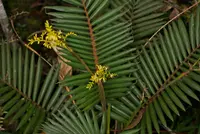
Yellow rotang palm, Calamus formosanus, is a climbing rattan palm native to Taiwan and nearby East Asian regions. It is mainly found in lowland and foothill forests. This species forms long, slender canes with hooked spines that help it scramble through surrounding vegetation. Its foliage is made of narrow, arching leaflets that give a light, feathery look. In cultivation, it is usually grown for its canes or as a specialty ornamental rather than a common houseplant. It prefers warm, humid conditions, filtered light, and consistently moist but well-drained soil. Understanding these natural preferences is key to how to care for Yellow Rotang Palm in cultivated settings.

Care Difficulty
Hard Care

Light Preference
Partial Shade

Water Requirements
Keep Soil Moist

Temperature Preference
Tropical / Frost Sensitive

Hardiness Zone
11–12

Soil Texture
Loamy, Silty, Organic-rich

Soil pH
Acidic (5.5–6.5), Slightly acidic (6.5–7.0)

Soil Drainage
Moist but well-drained

Fertilization
Minimal (feed rarely)
Scan your plant to receive care tips personalized for your specific plant
Available on iOS and Android
Calamus formosanus prefers bright, indirect light similar to a lightly shaded forest edge.
This rattan palm needs consistently moist but not waterlogged soil to stay healthy.
This species prefers warm, stable temperatures similar to a humid subtropical forest.
This palm requires consistently high humidity to grow well and avoid stress.
This species prefers moist, organic-rich, well-drained soil that stays evenly damp but never waterlogged.
This palm can be grown in large containers when its climbing and spreading habit is supported properly.
This palm responds to modest feeding but grows acceptably in lean, organic soils.
Pruning Calamus formosanus focuses on safety and tidiness rather than shaping.
This rattan palm is usually grown in the ground, so transplanting young plants matters more than repotting.
Propagation of Calamus formosanus is possible but slow and usually handled by experienced growers.
This subtropical rattan has low frost tolerance and needs protection in regions with cold winters.

Plant Health Check
Not sure what's wrong with your plant? Check your plant's health inside the app.
This rattan palm is naturally restricted to lowland and foothill forests of Taiwan, where it grows as a climbing understory species in warm, humid habitats.
The long, flexible stems bear hooked spines on the leaf sheaths and midribs, which act like grappling hooks that allow the plant to climb over surrounding vegetation instead of forming a self-supporting trunk.
In Taiwan, its tough, flexible canes have been locally used as a material for weaving and small-scale handicrafts, similar to other commercial rattans but on a more limited, regional basis.
Calamus formosanus is considered one of the few native rattan palms of Taiwan, and habitat loss has made some wild populations of this species a conservation concern, prompting interest in documenting and conserving its remaining natural stands.
Growth is slow to moderate. In suitable warm, humid conditions, this climbing rattan may extend canes by roughly 20–60 cm per year. Shaded, cool, or dry conditions slow extension significantly, especially in container culture.
Keep your plants happy and healthy with plant identification, disease detection, and easy care guidance.


Pumpkin
Cucurbita moschata 'Musquee de Provence'
 POPULAR
Creeping philodendron
Rhaphidophora decursiva
Wispy umbrella orchid
Bulbophyllum gracillimum
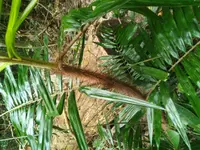
wait-a-while
Calamus australis
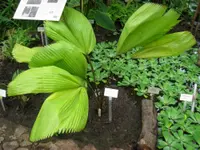
Ruffled fan palm
Licuala grandis
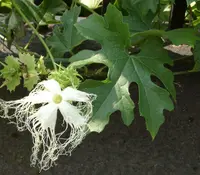
Chinese cucumber
Trichosanthes kirilowii
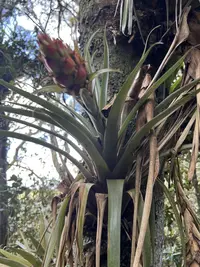
Tillandsia turneri
Tillandsia turneri
saw palmetto
Serenoa repens