Calceolaria crenatiflora Care

Calceolaria crenatiflora

About Calceolaria crenatiflora

Calceolaria crenatiflora is a compact, short-lived perennial often grown as a cool-season ornamental. It is known for its bright, pouch-shaped flowers that resemble small slippers in yellow and orange tones. The plant typically forms a low mound of soft green leaves and is most often used in pots, window boxes, and sheltered beds. It originates from cool, moist regions of Chile, which explains its preference for mild temperatures and consistent moisture. Due to its sensitivity to heat, irregular watering, and root rot, it is considered moderately challenging, especially indoors. Understanding how to care for Calceolaria crenatiflora helps keep it flowering for a longer display period.

Main Plant Requirements

Care Difficulty

Hard Care

Light Preference

Partial Shade

Water Requirements

Keep Soil Moist

Temperature Preference

Cool Climate

Hardiness Zone

8–10

Soil Texture

Loamy, Peaty, Organic-rich

Soil pH

Acidic (5.5–6.5)

Soil Drainage

Moist but well-drained

Fertilization

Light (every 4–6 weeks)

Get Personalized Care Plan

Scan your plant to receive care tips personalized for your specific plant

Available on iOS and Android

How to Care for the Calceolaria crenatiflora

This plant prefers bright, gentle light to support flowering without scorching its delicate leaves.

  • Provide 3–5 hours of soft morning sun with bright, filtered light the rest of the day; avoid harsh midday and afternoon sun, especially in summer.
  • Tolerates light partial shade, but very dim conditions reduce blooms and cause stretched, weak growth in Calceolaria crenatiflora.
  • In hot climates, use dappled shade under taller plants or sheer curtains; in winter, move to a brighter spot to compensate for shorter days and lower light angles.

This plant needs evenly moist, well-drained soil and reacts quickly to both drought and excess water.

  • Water when the top 2–3 cm of soil feels dry, letting water flow through freely and discarding any that collects in saucers or trays.
  • Choose a loose, well-draining mix; soggy, airless soil leads to yellowing leaves, soft stems, and root rot, while very dry soil causes wilting and crisp leaf edges.
  • In cool seasons, watering frequency usually decreases; observe leaf turgor and soil feel rather than following a fixed schedule for Calceolaria crenatiflora.

This cool-loving plant performs best in mild, stable temperatures without extremes.

  • Aim for 55–68°F (13–20°C) during active growth; flowers last longer at the cooler end of this range.
  • Protect from cold below 40°F (4°C); light frost can damage foliage, and hard frost usually kills the plant, especially in exposed beds or containers.
  • Heat above 77–80°F (25–27°C) often causes stress, wilting, and shorter flowering; provide shade, airflow, and consistent moisture during hot spells.

This species needs consistently moist, cool air and reacts quickly to dry indoor conditions.

  • Aim for 50–70% relative humidity to keep foliage and flower pouches firm and unblemished.
  • Dry air causes limp leaves, shriveling “pouch” flowers, and crisp brown edges on the youngest growth.
  • Increase humidity with a nearby humidifier or a wide pebble tray, but keep the pot base above standing water to prevent root problems.

This plant needs a light, airy, moisture-retentive but sharply draining substrate to avoid rapid decline.

  • Use a loose mix such as 2 parts peat or coco coir, 1 part fine compost, and 1 part perlite for structure and drainage.
  • Aim for slightly acidic to neutral pH around 6.0–7.0, avoiding strongly alkaline mixes that limit nutrient uptake.
  • Ensure water drains through within seconds; if it lingers or the pot feels heavy for long, increase perlite or add coarse sand.
  • Avoid dense garden soil or clay-based mixes that compact, exclude air around roots, and promote rot in Calceolaria crenatiflora.

This species is well suited to shallow decorative containers for short-term display.

  • Choose a wide, relatively shallow pot to match the fine, fibrous root system and reduce waterlogging risk at depth.
  • Favor lightweight plastic or glazed ceramic containers to keep moisture more even than porous terracotta, which dries out too fast.
  • Select a pot with generous drainage holes and elevate it slightly on pot feet so excess water clears quickly and does not reabsorb from saucers.

This plant benefits from light, careful feeding to support flowering without stressing its fine roots.

  • Use a balanced liquid fertilizer (for example 10-10-10) at 1/4–1/2 strength for Calceolaria crenatiflora during active growth.
  • Feed every 2–3 weeks in spring and early summer when buds and flowers are developing.
  • Avoid heavy compost or strong slow-release pellets, which can burn sensitive roots.
  • Stop feeding in late summer and keep plants unfertilized through winter dormancy.

Pruning is light and mainly focused on keeping the plant compact and encouraging more blooms.

  • After the main flowering flush, trim back spent flowering stems of Calceolaria crenatiflora by 1/3 to promote branching.
  • Remove dead, yellowing, or damaged leaves whenever noticed to limit disease.
  • Pinch soft shoot tips in early growth to create a fuller, bushier shape.
  • Use small, clean scissors or snips and disinfect blades if plants have shown disease.

This species is usually treated as a short-lived container ornamental, so repotting demands a gentle approach.

  • Check for roots circling the pot drainage holes or dense root mass as a sign it needs moving to a slightly larger pot.
  • Plan repotting for late winter to early spring, just before strong new growth begins.
  • Most plants only need 1 repot into a 2–3 cm wider container during their life cycle.
  • Minimize root stress by keeping the root ball mostly intact and watering thoroughly after shifting into fresh, free-draining mix.

Propagation is possible but somewhat delicate, so good hygiene and stable conditions are important.

  • Use fresh seeds of Calceolaria crenatiflora in late winter to early spring, sown on the surface of fine, moist seed compost.
  • Provide bright, indirect light and 65–70°F with high humidity for germination.
  • Do not cover seeds heavily; a light vermiculite dusting helps retain moisture without excluding light.
  • Transplant seedlings carefully once they have 2–3 true leaves, avoiding root disturbance.

This plant dislikes cold and is best treated as a cool-season annual or tender greenhouse subject in many climates.

  • Calceolaria crenatiflora is frost-sensitive and should be kept above 40°F whenever possible.
  • Move container plants indoors or into a cool, bright greenhouse before nights drop near freezing.
  • Water sparingly in winter, keeping the mix lightly moist but never saturated.
  • In mild climates, sheltered porch or cold-frame positions help buffer temperature swings.

Care Tips

Cool-season placement

Position plants in the coolest bright room available and keep them away from warm appliances or south-facing windows, as sustained heat shortens the flowering period noticeably.

Protect flower pouches

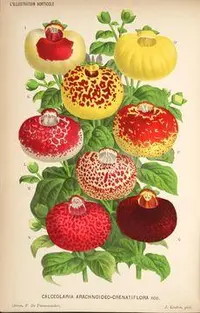
When moving or rotating the pot, handle it by the container rim and not the stems, since the inflated pouch-like flowers bruise easily and damaged blooms decline much faster.

Staggered sowing schedule

If growing from seed, start small batches 2–3 weeks apart under cool, bright conditions so flowering is spread over a longer season rather than peaking all at once.

Botrytis prevention routine

In cool, dense foliage conditions, remove spent blooms promptly and run a small fan on low nearby to keep air moving, which helps prevent gray mold (Botrytis) on the soft leaves and flowers when caring for Calceolaria crenatiflora.

Temporary outdoor hardening

In mild spring climates, harden pots off in bright shade outdoors for a few hours a day to toughen foliage and improve bud set, but bring them back inside before night temperatures drop below 45°F.

Common Pests and Diseases

Aphids

These insects cluster on young shoots, buds, and the undersides of leaves, sucking sap and causing distortion and sticky honeydew deposits. Symptoms include curled foliage, stunted new growth, and sometimes sooty mold growing on the honeydew.

Solution

Remove heavily infested shoot tips and rinse plants gently but thoroughly with lukewarm water to dislodge colonies. For persistent infestations, use insecticidal soap or a light horticultural oil, repeating at 5–7 day intervals and ensuring good air circulation while keeping the shallow root zone from drying out.

Whiteflies

These insects appear as small white moth-like adults that fly up when the plant is disturbed, with sap-sucking nymphs on leaf undersides. Symptoms include yellowing, wilting, sticky honeydew, and reduced flowering, especially under warm indoor or greenhouse conditions.

Solution

Hang yellow sticky traps to reduce adult numbers and inspect the undersides of leaves regularly, removing and discarding heavily infested foliage. Apply insecticidal soap or neem-based sprays to the undersides of leaves in the evening, and avoid overheating or overly dry air, which can favor rapid population growth.

Botrytis blight

This disease causes soft, water-soaked spots on leaves, buds, and flowers that quickly develop into gray, fuzzy mold, especially in cool, humid, low-light conditions. Symptoms include collapsing flower stems and mushy, discolored petals that fail to open properly.

Solution

Promptly remove and discard all affected flowers and foliage, and avoid wetting the leaves when watering. Improve ventilation, reduce humidity around the plant, and if needed apply a fungicide labeled for ornamental gray mold, while keeping spent blooms deadheaded to limit infection sites as part of general Calceolaria crenatiflora care instructions.

Powdery mildew

This disease produces white, powdery patches on leaves, stems, and sometimes flower stalks, often starting on older foliage. Symptoms include leaf yellowing, distortion, and early leaf drop, which can weaken compact, floriferous plants kept in stagnant indoor air.

Solution

Increase air movement around the plant, avoid crowding, and remove the most affected leaves to reduce spore load. Water the root zone instead of the foliage and, if the problem persists, use a labeled fungicidal spray such as sulfur or a potassium bicarbonate product, applying lightly and avoiding heat stress after treatment.

Leaf spot (fungal)

This disease causes small brown, purple, or dark spots on leaves that may merge into larger blotches, sometimes with yellow halos. Symptoms include progressive spotting from lower to upper leaves, leading to thinning foliage and reduced vigor in already short-lived plants.

Solution

Remove and discard spotted leaves as soon as they are noticed and keep plant debris off the soil surface. Water in the morning at the base of the plant, improve airflow, and if new spots continue to appear, use a gentle ornamental fungicide according to label directions while monitoring soil moisture closely to avoid overwatering the fine root system.

Interesting Facts

Native Andean origin

This species is native to the cool, misty slopes of central Chile, where it grows as a short-lived perennial or subshrub in open, often rocky habitats with good drainage and moderate temperatures.

Inflated pouch flowers

Its bright yellow flowers form a distinctive slipper- or pouch-shaped corolla, created by an enlarged lower lip that acts as a landing platform and chamber guiding pollinating insects toward the reproductive organs.

Genetic role in hybrids

Calceolaria crenatiflora has been widely used in breeding programs as a key parent for modern ornamental slipperwort hybrids, contributing compact growth, intense yellow coloration, and the characteristic inflated flower shape to many cultivated lines.

Botan icon

Did you know?

Because of its relatively stable morphology and widespread use in breeding, this species has served as an important reference taxon in molecular and morphological studies exploring the evolution and classification of the genus Calceolaria within the family Calceolariaceae.

FAQs about Calceolaria crenatiflora

This species works well as a short-lived indoor accent due to its bright pouch-like flowers and compact habit. It prefers cool rooms, good air circulation, and should be treated mainly as a temporary flowering display plant.

Grow Healthy Plants with Botan Care

Keep your plants happy and healthy with plant identification, disease detection, and easy care guidance.

Botan plant care app — identify plants on mobile

Explore More Plants