Spore Collection Setup
Place a sheet of wax paper or clean cardboard under mature puffballs before cutting so spores can be gathered cleanly and later spread over suitable habitat for new colonies.

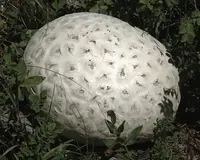
The Western giant puffball, Calvatia booniana, is a large puffball fungus rather than a leafy plant. It forms huge, rounded, white fruiting bodies that can resemble pale boulders on the ground. As it matures, the outer surface often cracks into irregular patches.
This species is native to western North America, where it appears in grasslands, open woods, and disturbed soils, usually in late summer to fall. It does not grow in pots like typical houseplants, so learning how to care for Western Giant Puffball focuses on encouraging suitable outdoor conditions. It generally prefers open light, undisturbed soil, and consistent, natural moisture rather than frequent watering.

Care Difficulty
Moderate Care

Light Preference
Partial Shade

Water Requirements
Regular Water

Temperature Preference
Cool Climate

Hardiness Zone
5–9

Soil Texture
Loamy, Sandy, Organic-rich

Soil pH
Slightly acidic (6.5–7.0), Neutral (7.0)

Soil Drainage
Moist but well-drained

Fertilization
Minimal (feed rarely)
Scan your plant to receive care tips personalized for your specific plant
Available on iOS and Android
Calvatia booniana develops best when its underground mycelium receives stable, moderate light conditions at the soil surface.
Water supports Calvatia booniana mainly by keeping the upper soil layer evenly moist without staying saturated.
This species fruits best in mild conditions with moderate temperature swings rather than extremes.
Humidity plays a minor role for Calvatia booniana, which behaves more like a soil fungus than a foliage houseplant.
Calvatia booniana develops best in loose, well-drained, organically enriched ground that mimics open meadow or disturbed field conditions.
This species is not well suited to container growing, as it naturally fruits from extensive underground mycelium in open soil.
This wild fungus usually grows without supplemental feeding, so home cultivation focuses on modest soil enrichment rather than strict fertilizing schedules.
Pruning is minimal for Calvatia booniana because the visible puffball is a temporary fruiting body rather than a long-lived plant structure.
This species is rarely grown in containers, so care focuses on transplanting or encouraging it in suitable ground conditions rather than classic repotting.
Propagation of Calvatia booniana is challenging for home growers because it depends on complex soil and fungal relationships.
Outdoor Calvatia booniana in suitable climates generally needs no special winter care, as the underground mycelium tolerates normal cold.

Plant Health Check
Not sure what's wrong with your plant? Check your plant's health inside the app.
Mature fruiting bodies develop a thick, white to tan outer skin covered with irregular polygonal warts or plates, which helps distinguish it from smoother-skinned giant puffball species.
Individual puffballs can reach very large sizes yet typically persist for only a brief period in the field before the interior tissue turns to olive-brown spores and the outer shell breaks down.
This species is especially common in open, dry habitats and disturbed sites such as pastures, road edges, and sandy or gravelly soils in western North America, rather than in shaded forest interiors.

The interior flesh of Calvatia booniana is considered edible only while it is uniformly firm and white, and it quickly becomes inedible as the tissue matures into a loose mass of spores, which can number in the trillions inside a single large puffball.
Young, firm specimens with solid white flesh are edible and often considered good table mushrooms. Once the interior turns yellow, green, or spongy, it should not be eaten. Always confirm identification carefully before consumption.
Keep your plants happy and healthy with plant identification, disease detection, and easy care guidance.