Establish central leader
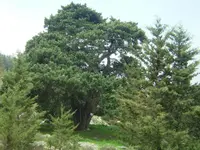
In the first 3–5 years, selectively remove or shorten competing upright shoots so one straight, dominant leader forms, which greatly improves long-term structure and fruit quality.

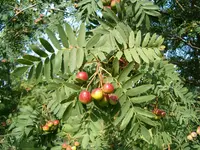
Service-tree, Cormus domestica, is a long-lived deciduous tree grown mainly for its hard timber and distinctive pear- or apple-like fruits. It develops a strong central trunk, a broad crown, and simple green leaves that turn attractive colors in autumn.
In nature it is native to parts of Europe and western Asia, where it grows in sunny woodland edges, open slopes, and hedgerows. It is generally considered a robust but slow-growing tree that dislikes waterlogged or very compacted soil.
Gardeners who care for Service-tree will find it prefers full sun, moderately fertile, well-drained soil, and steady but not excessive moisture.

Care Difficulty
Moderate Care

Light Preference
Full Sun

Water Requirements
Moderate Water

Temperature Preference
Cold Hardy

Hardiness Zone
5–8

Soil Texture
Sandy, Loamy, Clay

Soil pH
Slightly acidic (6.5–7.0), Slightly alkaline (7.0–7.5)

Soil Drainage
Well-drained

Fertilization
Minimal (feed rarely)
Scan your plant to receive care tips personalized for your specific plant
Available on iOS and Android
This species prefers full sun in cool climates and light shade in hotter regions.
This tree prefers evenly moist, well-drained soil and dislikes extremes of drought or saturation.
This hardy tree tolerates a wide temperature range but grows best in moderate conditions.
This species tolerates a wide humidity range and usually does not need special humidity management outdoors or in cool, airy spaces.
Cormus domestica prefers moderately fertile, well‑structured mineral soils that drain freely yet retain some moisture.
This species can be grown in large containers only for the first years, as it eventually outgrows pots.
This slow-growing tree often copes in modest soils, but light feeding supports steady growth and fruiting.
Cormus domestica benefits from modest structural pruning to keep a strong framework and healthy canopy.
This species is usually grown in the ground, so focus on careful transplanting of young trees rather than frequent repotting.
Propagation of Cormus domestica is possible but slow and often reserved for dedicated growers or conservation work.
Mature Cormus domestica is generally cold hardy in much of the temperate US and needs minimal winter attention.

Plant Health Check
Not sure what's wrong with your plant? Check your plant's health inside the app.
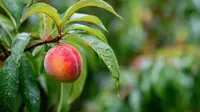
Cormus domestica is one of the rarest native wild fruit trees in parts of Europe and has been traditionally cultivated for its small, astringent pomes that are usually eaten only after bletting, when the flesh softens and sweetness increases.
The wood of this species is very dense, hard, and fine-grained, historically valued for precision tools, turnery, and specialty wooden objects where dimensional stability and wear resistance are important.
Natural populations often show considerable variation in fruit size, shape, and color, reflecting a long history of local selection and limited cultivation, which makes it of interest for studies on fruit tree domestication and diversity.

In several European regions, old Cormus domestica trees have been preserved as landmark or boundary trees, sometimes living for several centuries and serving as long-term reference points in traditional rural landscapes.
Fruits are edible when fully ripe or after bletting, becoming soft and brown. They are used for jams, fermented drinks, or eaten fresh in small amounts. Unripe fruits are very astringent and not pleasant to eat.
Keep your plants happy and healthy with plant identification, disease detection, and easy care guidance.