


Retain Moist Microhabitat
Leave a thin layer of well-decayed hardwood leaf litter or fine bark around existing colonies to mimic its natural woodland microhabitat and keep the substrate evenly cool and moist without waterlogging.

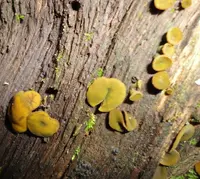
The olive-brown cup, Chlorencoelia versiformis, is a small cup fungus rather than a traditional leafy plant. It forms shallow, irregular discs or cups with olive-brown to dark brown surfaces, often clustered together on decaying wood or very wet, shaded forest edges.
This species is native to parts of Europe and North America, where it helps break down woody debris in cool, damp habitats. It is not commonly cultivated and is better observed in nature than grown at home, so information on how to care for olive-brown cup is limited.
In theory, it would favor consistently moist, humus-rich substrates, cool temperatures, and low to moderate light, similar to a damp woodland floor.

Care Difficulty
Hard Care

Light Preference
Shade

Water Requirements
Keep Soil Moist

Temperature Preference
Cool Climate

Hardiness Zone
Unknown

Soil Texture
Loamy, Silty, Organic-rich

Soil pH
Acidic (5.5–6.5)

Soil Drainage
Moist but well-drained

Fertilization
Minimal (feed rarely)
Scan your plant to receive care tips personalized for your specific plant
Available on iOS and Android
This small cup fungus naturally grows on shaded, decaying wood and needs low to moderate light rather than direct sun.
This fungus depends on consistently moist, but not waterlogged, wood and surrounding soil.
This species is adapted to cool, temperate woodland conditions and fruits best in mild, moist weather.
This wood-inhabiting fungus does best in consistently moist, high-humidity conditions around decaying hardwood.
Chlorencoelia versiformis grows on decaying hardwood rather than in true soil, so the substrate must mimic well-rotted forest wood and litter.
This species can be maintained in containers only as a specialized culture on hardwood pieces rather than as a typical potted plant.
Chlorencoelia versiformis is a saprophytic woodland fungus that gathers nutrients from decaying wood and does not benefit from conventional fertilization.
Pruning is not a standard practice for Chlorencoelia versiformis, as the fungus naturally completes its life cycle on dead or decaying wood.
This species is not suited to normal repotting and grows best on naturally decaying wood outdoors rather than in containers.
Deliberate propagation of Chlorencoelia versiformis is rarely attempted and remains unpredictable for most home growers.
In its natural range, the olive-brown cup is fully adapted to local winters and needs no special care.

Plant Health Check
Not sure what's wrong with your plant? Check your plant's health inside the app.
This fungus produces its small, olive-brown cup-shaped fruiting bodies very early in the year, often appearing in late winter to early spring when many other fungi are still absent.
It typically forms dense clusters on soil rich in buried decaying wood rather than on exposed logs, so the cups often seem to emerge directly from the ground along paths or in woodland clearings.
Originally described in the 19th century under a different genus, this species has been moved between several genera as microscopic and molecular studies refined its placement within the Helotiaceae family.
This fungus performs best outdoors, in cool, damp woodland or shaded garden conditions with decaying wood or rich organic debris. It is not suited to typical houseplant conditions, so olive-brown cup indoor care is generally unsuccessful.
Keep your plants happy and healthy with plant identification, disease detection, and easy care guidance.

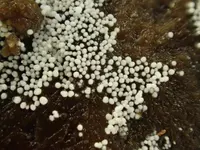
couscous crust
Bulbillomyces farinosus
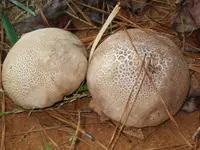
Purple-Spored Puffball
Calvatia cyathiformis
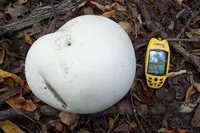
giant puffball
Calvatia gigantea

Sulphur Disco
Calycina claroflava
Poor Man's Licorice
Bulgaria inquinans
disc lichen
Buellia griseovirens
Golden Bolete
Buchwaldoboletus sphaerocephalus
Butyriboletus brunneus
Butyriboletus brunneus